
Medical Power of Attorney vs. Living Will
Who speaks for you when you can’t — and how do they know what to say?
Understanding who can make medical decisions for you — and how your wishes are known.
Published December 2025 • Updated June 2026
At a Glance
YOU ARE HERE:
Estate Planning Series → Phase 3 Article 2 of 7
Introduction: Medical Power of Attorney vs Living Will
“When your voice is gone, clarity must remain.”
The emergency room is quiet in the way only hospitals can be quiet — monitors humming, voices low, time stretched thin.
You’re conscious, but confused. Words come out wrong. The doctor turns to your family and asks a question that lands heavier than anyone expected:
“What would they want us to do?”
Everyone looks at each other.
Someone says, “I think…”
Another family member says, “We never talked about this.”
And someone pulls out a phone, hoping there’s an answer somewhere.
This is the moment when clear medical authority matters most. Without planning, families may discover it was never clearly established.
A Medical Power of Attorney and Living Will help protect your voice when you cannot speak for yourself. They also help protect your loved ones from having to guess during an already difficult moment.
When Your Voice Is Needed Most — and You Can’t Use It
Medical crises do not wait for clarity. They often demand decisions when emotions are high, information is incomplete, and time matters.
Without legal medical authority in place, hospitals may not simply look for the person who loves you most. They may need to know who has the legal right to consent, speak on your behalf, or make decisions when you cannot.
When that authority is unclear, decisions may be shaped by:
- hospital policies
- state laws
- family disagreement
- group consensus
- court involvement in more serious situations
A Medical Power of Attorney and Living Will help reduce that uncertainty by making your wishes and decision-maker clearer before a crisis occurs.
Medical Authority Is About Consent, Not Control
A Medical Power of Attorney names the person who is allowed to speak for you in medical situations if you cannot speak for yourself.
That authority matters because it helps identify:
- who may consent to treatment
- who may ask questions and receive information
- who may communicate your wishes
- whose voice doctors should follow when opinions conflict
This is not about medical expertise. It is about legal permission.
Without that permission clearly documented, even a spouse, adult child, or close family member may face delays or limitations when they are trying to help.
Real-Life Planning Scenario
“I’m Her Daughter…Why Can’t I Access the Account?”
Emily regularly helps her mother, Carol, with appointments, errands, and household needs.
After a sudden illness, Carol becomes unable to manage her finances. Emily assumes that being her daughter means she can access accounts, help pay bills, and handle urgent financial matters.
But the bank explains that family relationship alone does not give Emily legal authority.
Lesson:
Family relationship does not automatically create legal authority.
A Durable Power of Attorney can help make sure the person you trust has permission to act when needed.
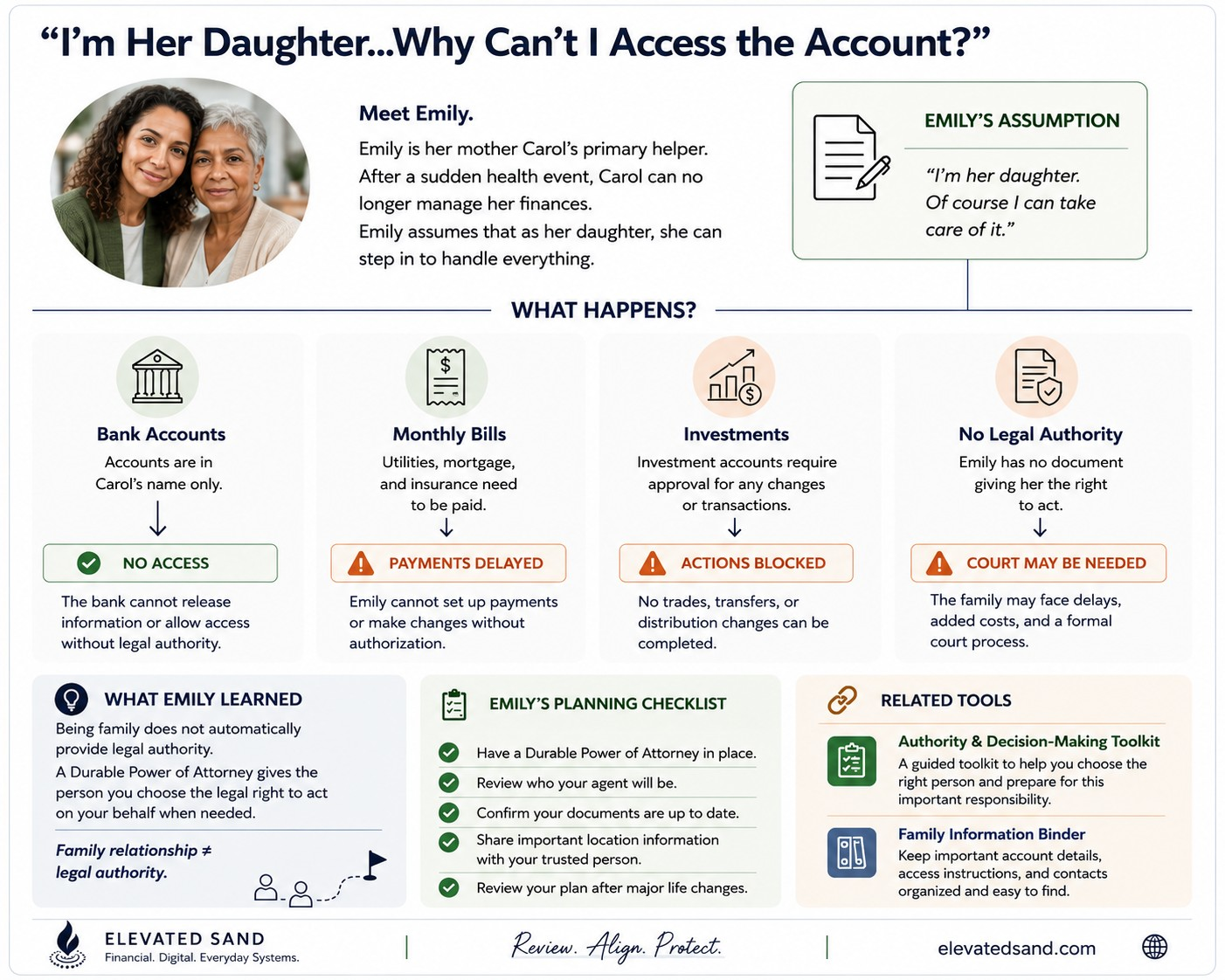
🔎 View Full Scenario → Explore more Estate Planning Scenarios
Why a Living Will Changes the Conversation
A Living Will does not replace a decision-maker. It supports one.
It puts your values and care preferences into writing — not as instructions for every possible situation, but as guidance when decisions are difficult and outcomes are uncertain.
In moments where there may not be one clear answer, your Living Will helps shift the question from:
“What should we do?”
to:
“What would they want?”
That shift matters.
It can reduce guilt, ease doubt, and help loved ones make decisions with more confidence.
FREE DOWNLOAD
📘 Health & Care Planning Toolkit
Medical decisions are easier to discuss before a crisis. The Health & Care Planning Toolkit helps you think through medical decision-making authority, care preferences, and the information loved ones may need during a health emergency. View resource →
Ambiguity Is the Real Enemy
Most medical conflicts do not begin with disagreement. They begin with uncertainty.
When authority and wishes are unclear:
- family members may disagree about who should decide
- doctors may not know whose direction to follow
- decisions may happen without clear personal guidance
- emotional strain may increase during an already painful time
One sibling may remember one conversation. Another may remember something different. A spouse may feel overridden. Adult children may feel responsible for choices they were never prepared to make.
Clear medical authority does not remove grief, but it can reduce confusion during a crisis.
⚖️ Why Medical and Financial Authority May Be Different Roles
It is common to assume that the person handling finances should also handle medical decisions.
But those responsibilities require different strengths.
Financial authority often requires:
- organization
- comfort with accounts and paperwork
- ability to manage systems and deadlines
Medical authority often requires:
- emotional steadiness
- ability to advocate under pressure
- willingness to honor your wishes even when decisions are hard
Sometimes the same person can handle both roles. Sometimes they should be separate.
Choosing different people is not about mistrust. It is about matching the responsibility to the person best equipped to carry it.
Choosing a Medical Agent Is an Act of Protection
The person you name as your medical agent may one day have to:
- ask difficult questions
- speak with doctors
- communicate with family
- advocate when others disagree
- honor your wishes under pressure
This is not only about who loves you most.
It is about who can remain steady, communicate clearly, and carry your voice when emotions are high.
Choosing thoughtfully protects your dignity and helps reduce pressure on the people you love.
The Quiet Relief of Clarity
When medical authority is clear, something changes in a crisis.
- Doctors know who to contact.
- Families know who is authorized to speak.
- Conversations can focus on care instead of conflict.
- Decisions are guided by values instead of pressure.
This clarity does not come from expecting the worst.
It comes from preparing the people you love with the information and authority they may one day need.
Final Thought
A Medical Power of Attorney and Living Will do not invite crisis. They prepare your loved ones for moments when clarity matters most.
Together, they help answer two important questions:
Who speaks for you when you cannot?
And how do they know what to say?
Answering those questions in advance is an act of care — for yourself and for everyone who may one day be asked to speak on your behalf.
Next Up: Estate Planning for Families with Children
Next, we’ll explore how estate planning choices can help protect children, clarify responsibilities, and create stability when others depend on you.
🔍 External Resources & Related Articles
The resources below offer additional perspective and support for navigating complex decisions around authority, family dynamics, and real-world preparedness. These materials are intended to help you think clearly and confidently as you plan.
📚 Trusted External Guidance
Organizations listed below provide clear, reputable information related to financial authority, medical decision-making, family protection, and planning during incapacity. Their materials are designed to support understanding and preparation—not to replace professional advice.
🌐 Consumer Financial Protection Bureau (CFPB) — Managing Someone Else’s Money
🌐 National Institute on Aging (NIH) — Advance Care Planning=
🌐 Social Security Administration (SSA) — Disability & Benefits Overview
🌐 FINRED (.gov) — Family & Financial Preparedness
🌐 ElderLawAnswers — Disability, Long-Term Care & Family Planning
🌐 The Conversation Project — End-of-Life Communication
🌐 Fidelity — Estate Planning & Health Care Planning
🌐 Charles Schwab — Estate, Family & Incapacity Planning
NOTE: These links are provided for additional education and exploration.
🎯 Related Phase 3 Articles
Articles below provide a quick list of all Phase 3 content. Explore real-world estate planning decisions involving authority, family relationships, and protection during uncertainty. Understand the considerations behind important choices before action is required.
📘 Durable Power of Attorney: Who Handles Finances if You Can’t
📘 Medical Power of Attorney & Living Will Explained
📘 Estate Planning for Families with Children
📘 Blended Families and Estate Planning Challenges
📘 Disability Trusts Explained (In Simple Terms)
📘 Avoiding Family Conflict: How to Talk About Estate Planning
📘 Keeping Your Estate Private: Wills, Trusts, and Confidentiality
Looking for more estate planning tools?
Explore the full collection on our Tools & Resources page.
About the Author: Tonya Harris
Tonya Harris is the founder of Elevated Sand. She creates culturally grounded financial, digital, and real-life education that helps people understand complex systems, make informed decisions, and build stronger foundations for the future.
JOIN THE COMMUNITY
Sign up & get updates
Join our community for practical insights, financial tips, and tools to help you grow, protect, and elevate your life — one step at a time.
Disclaimer: Information is for educational purposes only and should not be considered legal or financial advice. Estate planning involves complex legal and tax considerations. You should consult a qualified estate planning attorney to determine the best approach for your situation and ensure compliance with your state’s laws.