
Avoiding Family Conflict: How to Talk About Estate Planning
Silence creates confusion. Conversation creates stability.
Thoughtful conversations help families reduce misunderstandings, clarify expectations, and protect relationships before important decisions are ever needed.
Published December 2025 • Updated June 2026
At a Glance
YOU ARE HERE:
Estate Planning Series → Phase 3 Article 6 of 7
Introduction: Avoiding Family Conflict
No one said anything because no one wanted to make things uncomfortable.
Years later, after a loss, the silence becomes the loudest voice in the room.
“I didn’t know that was the plan.”
“They promised me something different.”
“Why didn’t anyone tell us?”
Most family conflict around estate planning does not begin with greed.
It often begins with assumptions left unchallenged — and conversations postponed until they can no longer help.
Estate planning conversations are not always easy, but silence can leave loved ones trying to answer questions you never intended them to carry.
Silence Feels Polite. It Isn’t Protective.
Families often avoid estate planning conversations for understandable reasons.
They do not want to:
- worry anyone
- create tension
- hurt feelings
- seem controlling or unfair
So they wait.
But silence does not always preserve peace.
It can create uncertainty.
And uncertainty leaves room for different interpretations, expectations, and assumptions.
By the time decisions are needed, emotions may already be high and important context may be missing.
Communication Is a Preventive Tool — Not a Negotiation
Talking about estate planning does not mean asking everyone to approve your decisions.
It means reducing surprise.
There is an important difference between disclosure and debate.
Disclosure says:
“This is the structure I’ve put in place, and I want you to understand it.”
Debate says:
“Everyone needs to agree before I decide.”
The goal is not always consensus.
The goal is helping loved ones understand your intentions before they are left interpreting them.
Why Avoidance Is So Common — and So Costly
Avoidance often comes from good intentions.
Parents may want to protect children from worry.
Adult children may not want to ask uncomfortable questions.
Blended families may fear reopening old wounds.
But when expectations are never addressed, they do not disappear.
People naturally fill in missing information with what seems reasonable to them.
The challenge is that everyone’s version of reasonable may look different.
That is when conflict begins to feel personal instead of simply unresolved.
⚖️ Real-Life Planning Scenario
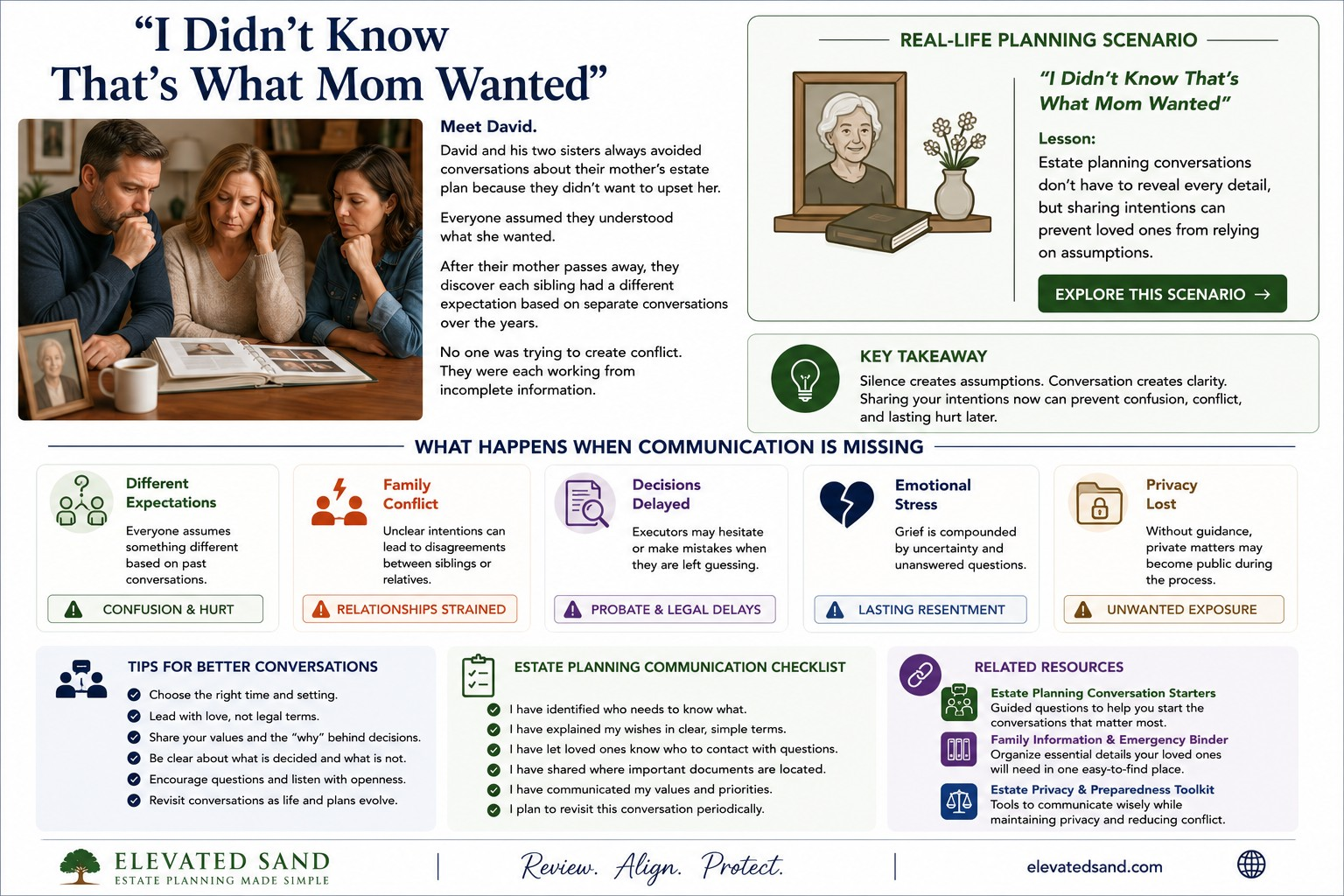
Misaligned Expectations Are the Real Trigger
Many estate disagreements begin with one thought:
“I thought it would be different.”
That expectation may come from:
- a conversation years earlier
- an assumption based on family roles
- a belief about what feels fair
- a promise remembered differently by different people
Without clear communication, loved ones may focus on trying to determine what someone meant instead of following what was intended.
Clarity helps protect both the plan and the relationships around it.
Sharing Intent Without Sharing Every Detail
Effective communication does not require revealing every financial detail.
It requires sharing enough guidance to reduce confusion.
Loved ones may benefit from understanding:
- that a plan exists
- who has important responsibilities
- where key information can be found
- who they should contact with questions
- the values behind important decisions
Providing context helps loved ones feel prepared instead of surprised.
FREE DOWNLOAD
📘 Estate Privacy & Preparedness Toolkit
Planning conversations require a balance between privacy and preparation.
The Estate Privacy & Preparedness Toolkit helps families organize important information, communicate thoughtfully, and provide guidance without sharing more than they are comfortable sharing. View resource →
Boundaries Preserve Relationships
One of the hardest parts of estate planning conversations is balancing openness with boundaries.
It is possible to say:
- “I’m sharing this so there is clarity.”
- “I want you to understand my decisions.”
- “This reflects what I believe is best.”
Sharing information does not mean every choice becomes a group decision.
Healthy boundaries help conversations stay focused on understanding instead of disagreement.
When Conversations Don’t Happen
When families do not talk:
- executors may inherit confusion instead of guidance
- siblings may question decisions they do not understand
- loved ones may search for meaning in documents they were not prepared to receive
Trying to understand someone’s wishes during grief is difficult.
Planning conversations give families context before they need it.
Final Thought
Avoiding family conflict does not require perfect conversations.
It requires timely ones.
Sharing intentions before they are needed gives loved ones the opportunity to understand your decisions without pressure, grief, or urgency.
It replaces assumptions with clarity.
The goal is not that everyone agrees.
The goal is that no one is left guessing.
Next Up: Keeping Your Estate Private: Wills, Trusts, and Confidentiality
Some planning decisions require communication. Others require privacy.
Next, we’ll explore how wills, trusts, and thoughtful organization can affect what stays private and what becomes public.
🔍 External Resources & Related Articles
The resources below offer additional perspective and support for navigating complex decisions around authority, family dynamics, and real-world preparedness. These materials are intended to help you think clearly and confidently as you plan.
📚 Trusted External Guidance
These organizations provide clear, reputable information related to financial authority, medical decision-making, family protection, and planning during incapacity. Their materials are designed to support understanding and preparation—not to replace professional advice.
🌐 Consumer Financial Protection Bureau (CFPB) — Managing Someone Else’s Money
🌐 National Institute on Aging (NIH) — Advance Care Planning=
🌐 Social Security Administration (SSA) — Disability & Benefits Overview
🌐 FINRED (.gov) — Family & Financial Preparedness
🌐 ElderLawAnswers — Disability, Long-Term Care & Family Planning
🌐 The Conversation Project — End-of-Life Communication
🌐 Fidelity — Estate Planning & Health Care Planning
🌐 Charles Schwab — Estate, Family & Incapacity Planning
NOTE: These links are provided for additional education and exploration.
🎯 Related Phase 3 Articles
These articles explore real-world estate planning decisions involving authority, family relationships, and protection during uncertainty. Each piece is designed to help you understand the considerations behind important choices before action is required.
📘 Durable Power of Attorney: Who Handles Finances if You Can’t
📘 Medical Power of Attorney & Living Will Explained
📘 Estate Planning for Families with Children
📘 Blended Families and Estate Planning Challenges
📘 Disability Trusts Explained (In Simple Terms)
📘 Avoiding Family Conflict: How to Talk About Estate Planning
📘 Keeping Your Estate Private: Wills, Trusts, and Confidentiality
Looking for more estate planning tools?
Explore the full collection on our Tools & Resources page.
About the Author: Tonya Harris
Tonya Harris is the founder of Elevated Sand. She creates culturally grounded financial, digital, and real-life education that helps people understand complex systems, make informed decisions, and build stronger foundations for the future.
JOIN THE COMMUNITY
Sign up & get updates
Join our community for practical insights, financial tips, and tools to help you grow, protect, and elevate your life — one step at a time.
Disclaimer: Information is for educational purposes only and should not be considered legal or financial advice. Estate planning involves complex legal and tax considerations. You should consult a qualified estate planning attorney to determine the best approach for your situation and ensure compliance with your state’s laws.