
Durable Power of Attorney: Who Handles Your Finances if You Can’t?
Financial authority doesn’t pause when life does.
A Durable Power of Attorney determines who can act on your behalf, manage financial responsibilities, and protect your interests if you’re unable to do so yourself — without unnecessary court delays or confusion.
Originally Published: December 2025 • Last Updated: June 2026
At a Glance
YOU ARE HERE:
Estate Planning Series → Phase 3 Article 1 of 7
Introduction: Durable Power of Attorney
Most people assume that if something happens to them, their spouse, partner, or adult child will automatically be able to step in and manage their finances.
That assumption can create unexpected challenges — especially when decisions need to be made quickly.
A Durable Power of Attorney exists for one important reason: to clearly identify who has financial authority if you’re unable to act for yourself.
When Life Interrupts, Money Doesn’t Stop
Incapacity rarely arrives neatly.
- It can look like a sudden stroke.
- A surgery with complications.
- A concussion that lingers longer than expected.
- A mental health crisis.
- Early cognitive decline.
- A prolonged hospital stay where you’re conscious but not capable.
During those moments, bills still come due. Mortgage payments don’t pause. Insurance claims don’t wait. Payroll still has to run. Taxes still have deadlines.
Without legal authority in place, the people closest to you may discover that being family does not automatically provide permission to act.
What a Durable Power of Attorney Really Does
A Durable Power of Attorney does more than allow someone to help — it grants legal authority.
It names one person — your agent — who is allowed to act as you for financial matters when you cannot. This person is not simply helping with tasks — they are the person legally authorized to act on your behalf.
“Durable” means that authority survives incapacity. Without that durability language, the document fails at the exact moment it’s needed most.
This is not just a backup document. It is an important part of your financial protection plan.
What Happens When No One Has Authority
When no Durable Power of Attorney exists, families are often forced into court-supervised solutions like conservatorships or guardianships.
That process is rarely just legal — it’s emotional.
Loved ones must:
- Prove incapacity
- Justify why they should be in charge
- Pay legal fees
- Wait for approvals
- Operate under ongoing court oversight
Even families who agree can find the process stressful. Existing disagreements can make decisions even more difficult.
A Durable Power of Attorney helps provide direction during moments when your family needs clarity most.
Choosing an Agent Means Choosing Responsibility
This is not an honorary role. It is not about closeness. It is not about obligation.
Your agent may control:
- Access to bank and investment accounts
- Payment of major bills
- Management of property or businesses
- Tax filings and government interactions
- Financial decisions with long-term consequences
That level of authority requires more than good intentions. It requires judgment, restraint, reliability, and emotional steadiness under pressure.
Choosing the right person matters because this role carries significant responsibility and trust.
FREE DOWNLOAD
📘 Authority & Decision-Making Toolkit
A guided toolkit to help you think through who should hold financial authority during incapacity, what that role truly involves, and whether your chosen agent is prepared to act in your best interest. View resource →
The Weight of Trust (and the Reality of Family Dynamics)
Many people default to naming:
- The oldest child
- The most vocal relative
- The person who “expects” the role
But financial authority magnifies existing dynamics. Old resentments surface. Siblings question decisions. Partners feel sidelined. Stress can highlight challenges that were easier to manage before.
A Durable Power of Attorney doesn’t just name an agent — it shapes how your family experiences crisis.
Thoughtful selection can preserve relationships. A thoughtful choice can help reduce confusion and unnecessary conflict.
Timing Matters More Than People Realize
Once incapacity occurs, it is often too late to sign or update a Durable Power of Attorney.
These documents generally cannot be created retroactively once someone lacks legal capacity to sign them.
This makes the Durable Power of Attorney one of the few estate planning tools that must be completed before it’s needed — not after a diagnosis, not during a hospitalization, and not once questions of capacity arise.
Why Financial Authority Deserves Its Own Focus
Many people lump financial authority in with “estate planning paperwork” and move on.
But financial authority:
- Operates while you are alive
- Affects day-to-day stability
- Intersects with family trust
- Carries legal liability
- Requires clarity, not assumptions
This is why financial authority planning deserves deliberate attention — not a checkbox.
The Value of Having a Clear Plan
When a Durable Power of Attorney is in place — and properly chosen — something subtle but powerful happens.
- Loved ones understand who can act.
- Financial responsibilities can continue.
- Decisions have a clear process.
- Everyone has a better understanding of the plan.
Instead, there is clarity. Direction. Authority. Continuity.
Not because the moment isn’t hard — but because the rules are already set.
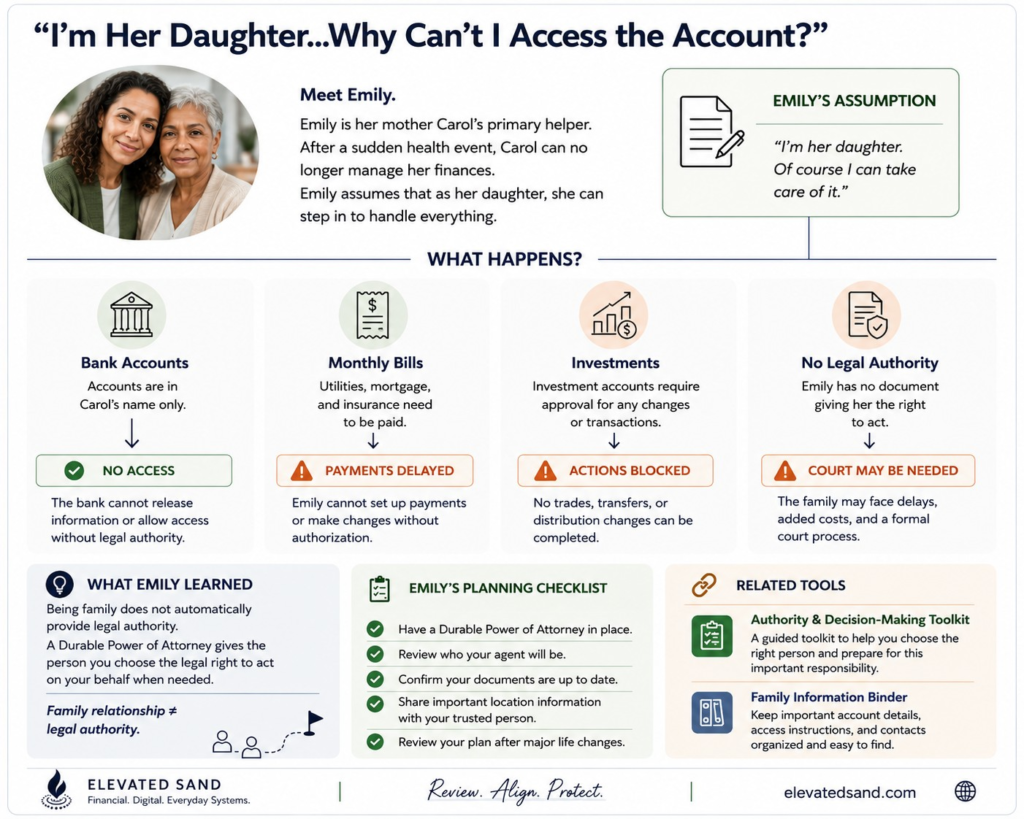
⚖️ Real-Life Planning Scenario
“I’m Her Daughter…Why Can’t I Access the Account?”
Final Thought
A Durable Power of Attorney answers a question most families don’t want to think about:
Who has the authority to handle financial decisions if you cannot?
Choosing that person — carefully, intentionally, and ahead of time — is one of the most protective decisions you can make for both yourself and the people you love.
Next Up: Medical Power of Attorney & Living Will Explained
Financial authority is only one side of protection.
Next, we’ll explore how medical decisions are made, who speaks for you when you can’t, and why separating financial and medical authority matters more than most families realize.
🔍 External Resources & Related Articles
The resources below offer additional perspective and support for navigating complex decisions around authority, family dynamics, and real-world preparedness. These materials are intended to help you think clearly and confidently as you plan.
📚 Trusted External Guidance
These organizations provide clear, reputable information related to financial authority, medical decision-making, family protection, and planning during incapacity. Their materials are designed to support understanding and preparation—not to replace professional advice.
🌐 Consumer Financial Protection Bureau (CFPB) — Managing Someone Else’s Money
🌐 National Institute on Aging (NIH) — Advance Care Planning=
🌐 Social Security Administration (SSA) — Disability & Benefits Overview
🌐 FINRED (.gov) — Family & Financial Preparedness
🌐 ElderLawAnswers — Disability, Long-Term Care & Family Planning
🌐 The Conversation Project — End-of-Life Communication
🌐 Fidelity — Estate Planning & Health Care Planning
🌐 Charles Schwab — Estate, Family & Incapacity Planning
NOTE: These links are provided for additional education and exploration.
🎯 Related Phase 3 Articles
These articles explore real-world estate planning decisions involving authority, family relationships, and protection during uncertainty. Each piece is designed to help you understand the considerations behind important choices before action is required.
📘 Durable Power of Attorney: Who Handles Finances if You Can’t
📘 Medical Power of Attorney & Living Will Explained
📘 Estate Planning for Families with Children
📘 Blended Families and Estate Planning Challenges
📘 Disability Trusts Explained (In Simple Terms)
📘 Avoiding Family Conflict: How to Talk About Estate Planning
📘 Keeping Your Estate Private: Wills, Trusts, and Confidentiality
Looking for more estate planning tools?
Explore the full collection on our Tools & Resources page.
About the Author: Tonya Harris
Tonya Harris is the founder of Elevated Sand. She creates culturally grounded financial, digital, and real-life education that helps people understand complex systems, make informed decisions, and build stronger foundations for the future.
JOIN THE COMMUNITY
Sign up & get updates
Join our community for practical insights, financial tips, and tools to help you grow, protect, and elevate your life — one step at a time.
Disclaimer: Information is for educational purposes only and should not be considered legal or financial advice. Estate planning involves complex legal and tax considerations. You should consult a qualified estate planning attorney to determine the best approach for your situation and ensure compliance with your state’s laws.