
Keeping Your Estate Private: Wills, Trusts, and Confidentiality
Privacy is control — not secrecy.
Thoughtful planning helps families protect sensitive information, organize important details, and decide what should remain private during life’s most difficult transitions.
Published December 2025 • Updated June 2026
At a Glance
YOU ARE HERE:
Estate Planning Series → Phase 3 Article 7 of 7
Introduction: Keeping Your Estate Private
The family thought everything would stay between them.
- The decisions.
- The documents.
- The details.
But after a loss, they discovered some information could become accessible through legal processes they never understood.
The family was not trying to hide anything.
They simply did not realize privacy required planning.
Estate privacy is not about secrecy.
It is about understanding who has access, who has authority, and how sensitive information is handled when life changes.
Privacy Is Control, Not Secrecy
Many families hesitate to talk about estate privacy because it feels uncomfortable — as if wanting discretion means having something to hide.
It does not.
Privacy is about boundaries.
It is deciding:
- who receives sensitive information
- who has decision-making authority
- where important documents are stored
- who knows how to access what is needed
When those choices are not made intentionally, families may have less control over how information is discovered or shared.
Public Exposure Happens Faster Than People Expect
Many people do not realize that some estate processes may create records others can access.
Depending on the situation, information may include:
- estate documents
- asset information
- names of interested parties
- disputes or filings
- decisions made during administration
For many families, the surprise is not only what information exists.
It is realizing they never considered who might see it.
Planning ahead helps families think intentionally about privacy before decisions are needed.
Why Discretion Matters to Families
Privacy protects more than information.
It protects relationships.
When sensitive decisions become widely visible, loved ones may:
- question choices without understanding context
- compare outcomes
- revisit old disagreements
- feel pressure during an already emotional time
Discretion helps keep the focus where it belongs:
on care, responsibility, and carrying out the plan.
⚖️ Real-Life Planning Scenario
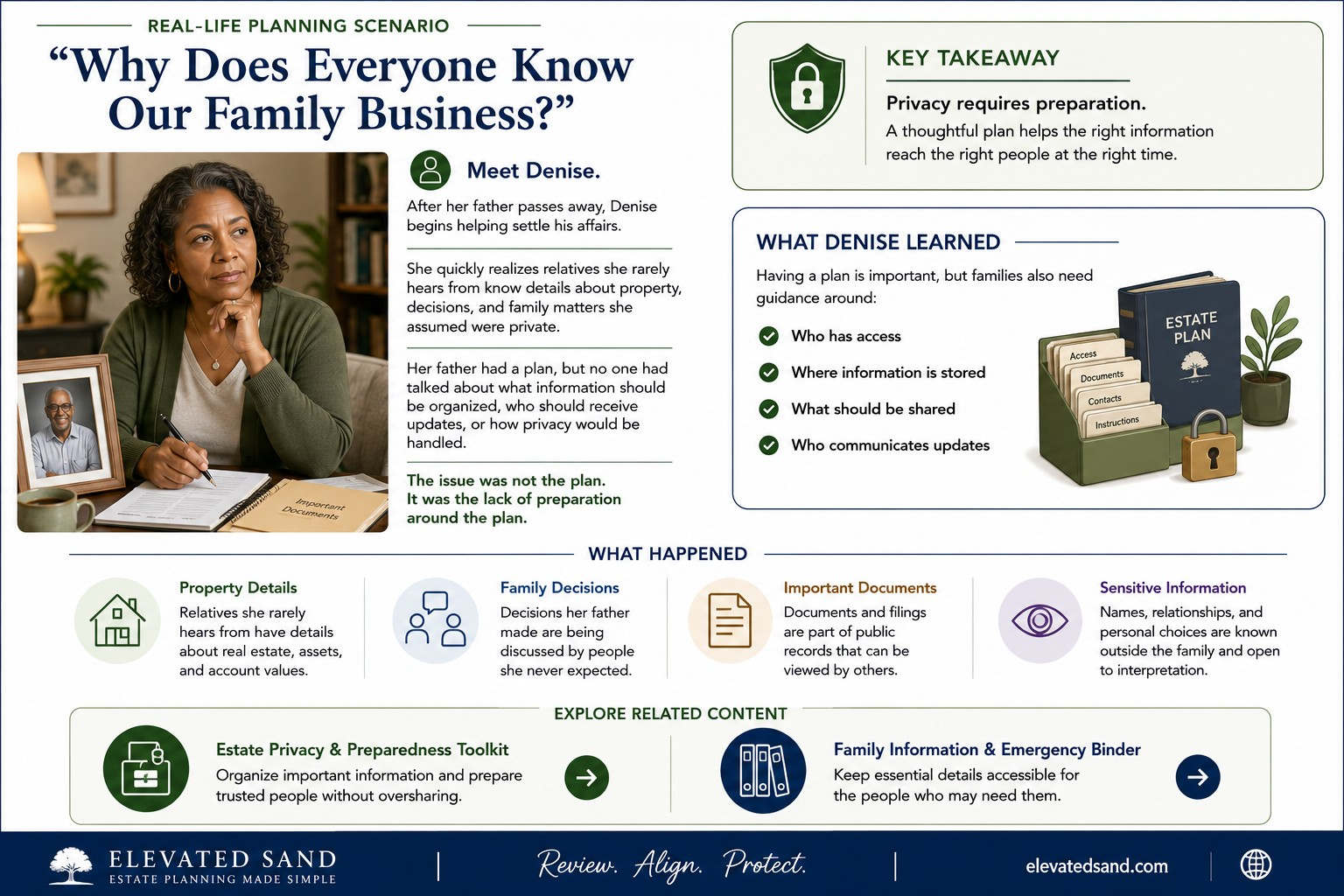
Unintended Disclosure Creates Conflict
Family conflict is not always caused by the decisions themselves.
Sometimes it comes from how those decisions are discovered.
When information appears without context:
- assumptions form
- comparisons happen
- emotions influence interpretation
- private choices feel unexpected
Even thoughtful plans can create confusion when families do not understand the structure around them.
Privacy planning helps families decide what should be shared, when, and with whom.
FREE DOWNLOAD
📘 Estate Privacy & Preparedness Toolkit
Keeping information private requires more than having documents.
The Estate Privacy & Preparedness Toolkit helps families organize important details, think through access, and prepare loved ones without sharing more than necessary. View resource →
Privacy Is Especially Critical in Complex Families
Some family situations create additional layers of planning.
Examples include:
- blended families
- prior marriages
- different financial circumstances
- caregiving responsibilities
- beneficiaries with unique needs
When information is incomplete or unexpected, loved ones may create their own explanations.
Clear communication and thoughtful privacy boundaries help reduce confusion.
Organization Reduces Confusion
When authority is clear and information is organized:
- decision-makers know their role
- loved ones know where to find guidance
- important details are easier to locate
- fewer assumptions are needed
This is not about hiding information.
It is about making sure the right information reaches the right people at the right time.
Final Reflection: Preparedness Is Protection
Estate planning is not only about documents.
It is about the people who may one day depend on those documents.
Throughout this series, the same themes appear again and again:
- clarity reduces confusion
- communication protects relationships
- authority prevents uncertainty
- organization supports the people you trust
A thoughtful plan does not draw attention to itself.
It quietly supports loved ones when they need guidance most.
That is what preparation provides.
Continue Your Planning Journey
Estate planning is not something you finish once. It is something you revisit as your life, family, finances, and priorities change.
From here, you can:
🔁 Review earlier articles when questions come up
🧩 Explore planning resources and checklists
💬 Start important conversations with loved ones
📩 Stay connected as new guides and tools are added
You do not need to solve everything today. Progress comes from continuing to make thoughtful decisions one step at a time.
Continue Exploring
🔍 External Resources & Related Articles
The resources below offer additional perspective and support for navigating complex decisions around authority, family dynamics, and real-world preparedness. These materials are intended to help you think clearly and confidently as you plan.
📚 Trusted External Guidance
These organizations provide clear, reputable information related to financial authority, medical decision-making, family protection, and planning during incapacity. Their materials are designed to support understanding and preparation—not to replace professional advice.
🌐 Consumer Financial Protection Bureau (CFPB) — Managing Someone Else’s Money
🌐 National Institute on Aging (NIH) — Advance Care Planning=
🌐 Social Security Administration (SSA) — Disability & Benefits Overview
🌐 FINRED (.gov) — Family & Financial Preparedness
🌐 ElderLawAnswers — Disability, Long-Term Care & Family Planning
🌐 The Conversation Project — End-of-Life Communication
🌐 Fidelity — Estate Planning & Health Care Planning
🌐 Charles Schwab — Estate, Family & Incapacity Planning
NOTE: These links are provided for additional education and exploration.
🎯 Related Phase 3 Articles
These articles explore real-world estate planning decisions involving authority, family relationships, and protection during uncertainty. Each piece is designed to help you understand the considerations behind important choices before action is required.
📘 Durable Power of Attorney: Who Handles Finances if You Can’t
📘 Medical Power of Attorney & Living Will Explained
📘 Estate Planning for Families with Children
📘 Blended Families and Estate Planning Challenges
📘 Disability Trusts Explained (In Simple Terms)
📘 Avoiding Family Conflict: How to Talk About Estate Planning
📘 Keeping Your Estate Private: Wills, Trusts, and Confidentiality
Looking for more estate planning tools?
Explore the full collection on our Tools & Resources page.
About the Author: Tonya Harris
Tonya Harris is the founder of Elevated Sand. She creates culturally grounded financial, digital, and real-life education that helps people understand complex systems, make informed decisions, and build stronger foundations for the future.
JOIN THE COMMUNITY
Sign up & get updates
Join our community for practical insights, financial tips, and tools to help you grow, protect, and elevate your life — one step at a time.
Disclaimer: Information is for educational purposes only and should not be considered legal or financial advice. Estate planning involves complex legal and tax considerations. You should consult a qualified estate planning attorney to determine the best approach for your situation and ensure compliance with your state’s laws.