
Blended Families and Estate Planning Challenges
Love is complex. Planning must be clear.
Blended families often carry layered relationships, shared histories, and different expectations. Clear planning helps reduce confusion, protect loved ones, and prevent silence from turning into conflict.
Published December 2025 • Updated June 2026
At a Glance
YOU ARE HERE:
Estate Planning Series → Phase 3 Article 4 of 7
Introduction: Blended Families and Estate Planning Challenges
The conversation never happened — and everyone assumed that meant everything was fine.
A second marriage. Adult children from a first relationship. Stepchildren who feel like family, but are not sure where they stand. A home filled with shared memories, but no clear understanding of what happens next.
When something happens, assumptions rush in to fill the silence.
“I thought we agreed…”
“They would have wanted it this way.”
“That’s not fair.”
In blended families, estate planning is not only about who receives what.
It is about expectations, loyalty, security, and trust — and what happens when those things are not clearly documented.
Where Love and Loyalty Quietly Collide
Blended families often carry history.
Children may remember promises made before remarriage.
Spouses may expect security after building a life together.
Stepchildren may wonder whether emotional closeness also means legal inclusion.
Everyone’s feelings may be valid, but feelings alone do not resolve decisions when authority and instructions are unclear.
Without intentional planning, the people you love can end up on opposite sides of choices you never meant to leave unresolved.
Fairness and Clarity Are Not the Same Thing
Many blended-family conflicts begin because everyone has a different idea of what “fair” means.
Fairness is personal.
Clarity is protective.
One child may need more support.
One spouse may depend on shared assets for stability.
One relationship may have started later but still carries deep commitment.
One family member may expect something that was never clearly promised.
When those distinctions are not explained, silence becomes interpretation — and interpretation can become conflict.
A clear plan does not make every decision easy, but it helps loved ones understand what you intended.
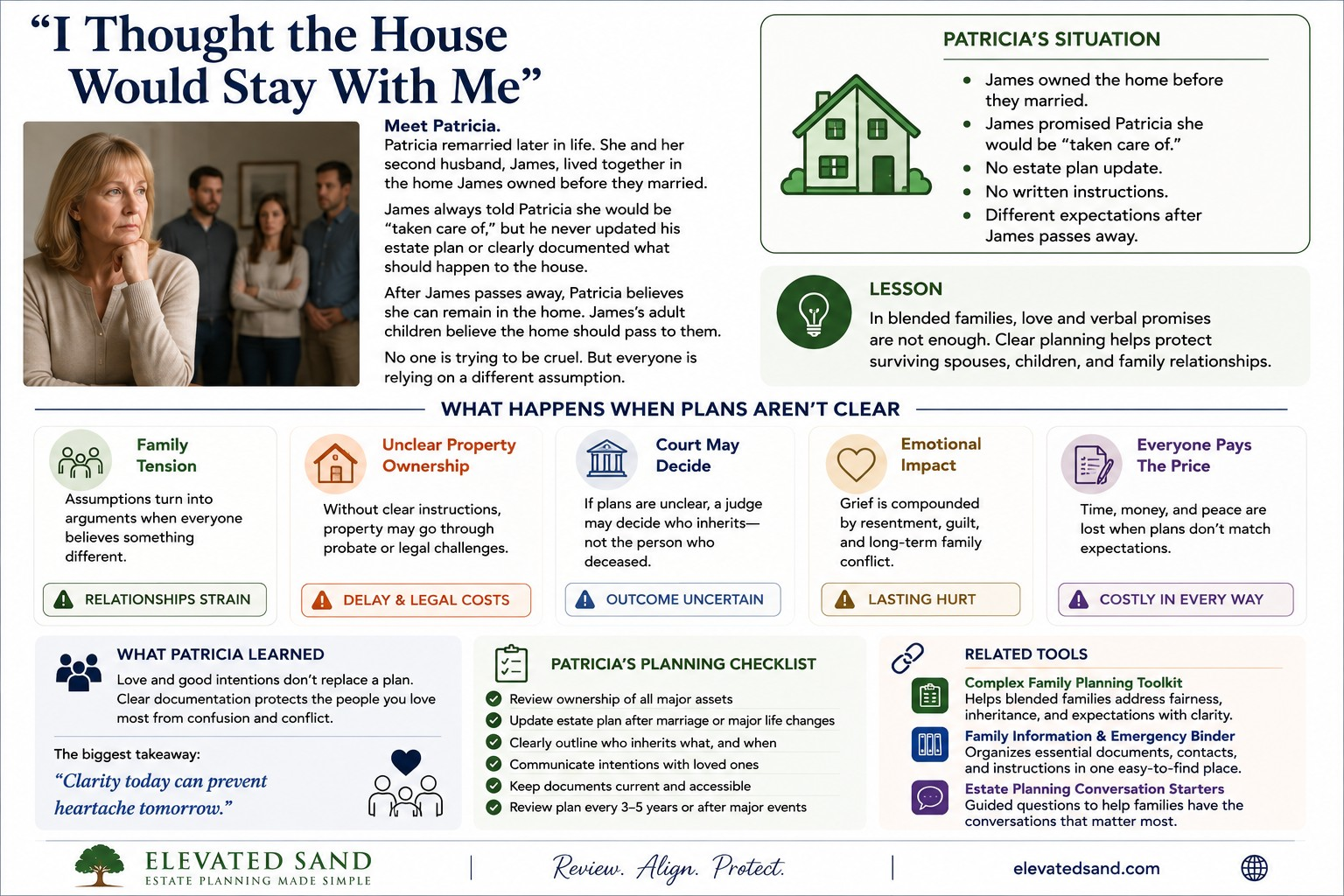
⚖️ Real-Life Planning Scenario
FREE DOWNLOAD
📘 Complex Family Planning Toolkit
Blended family planning can bring up difficult questions about fairness, inheritance, authority, and expectations.
The Complex Family Planning Toolkit helps families think through layered relationships, clarify priorities, and reduce confusion before conflict begins.
View resource →
The Risk of Saying Nothing
Silence is often chosen to keep the peace.
- Parents avoid difficult conversations.
- Couples postpone decisions.
- Adult children make assumptions.
- Everyone hopes intentions will be obvious later.
But later is often a moment of grief, stress, or shock — when no one is at their best.
When plans are unclear:
- adult children may feel displaced
- surviving spouses may feel scrutinized
- stepchildren may feel excluded or uncertain
- old resentments may resurface
- decisions may feel personal instead of intentional
The absence of clarity forces loved ones to interpret your wishes without you.
Blended Families Require Deliberate Authority
In blended families, authority should not be assumed.
It needs to be clearly defined.
Important questions include:
- Who can make decisions if you cannot?
- Who manages assets?
- Who receives what, and when?
- Who has responsibility when interests overlap?
- What should happen to shared property?
These questions do not imply mistrust.
They acknowledge reality.
Clear authority can help protect:
- spouses from suspicion
- children from uncertainty
- stepchildren from unclear expectations
- family relationships from unnecessary strain
Emotional Weight Doesn’t Disappear After Loss
Families often underestimate how long these tensions can last.
Disputes over money, property, or personal belongings may reflect deeper wounds:
- feeling replaced
- feeling forgotten
- feeling less valued
- feeling excluded from a family story
When plans are vague, every decision can feel like a statement about relationships instead of a clear instruction being followed.
Clarity does not eliminate grief.
But it can prevent grief from turning into resentment.
When Planning Must Account for More Than Inheritance
Blended families may also face planning needs that go beyond dividing assets.
These may include:
- different financial starting points
- unequal dependency
- children with different needs
- long-term care concerns
- disability or vulnerability within the family
- shared property from different stages of life
When these realities are not addressed clearly, the most vulnerable people may be left uncertain.
This is where blended-family planning can connect with long-term care, disability planning, beneficiary reviews, and family communication.
Final Thought
Blended families do not struggle because they are complex.
They struggle when silence is mistaken for harmony.
Clear planning is not about choosing sides.
It is about honoring the people you love by removing ambiguity before they are forced to interpret your wishes.
When expectations are stated and authority is defined, love does not have to compete with logistics.
Families are spared from making difficult decisions without guidance.
Next Up: Disability Trusts Explained
When long-term care, disability, or ongoing dependency enters the picture, planning must go beyond inheritance.
Next, we’ll explore how disability trusts can help protect dignity, preserve benefits, and provide stability for loved ones with ongoing care needs.
🔍 External Resources & Related Articles
The resources below offer additional perspective and support for navigating complex decisions around authority, family dynamics, and real-world preparedness. These materials are intended to help you think clearly and confidently as you plan.
📚 Trusted External Guidance
These organizations provide clear, reputable information related to financial authority, medical decision-making, family protection, and planning during incapacity. Their materials are designed to support understanding and preparation—not to replace professional advice.
🌐 Consumer Financial Protection Bureau (CFPB) — Managing Someone Else’s Money
🌐 National Institute on Aging (NIH) — Advance Care Planning=
🌐 Social Security Administration (SSA) — Disability & Benefits Overview
🌐 FINRED (.gov) — Family & Financial Preparedness
🌐 ElderLawAnswers — Disability, Long-Term Care & Family Planning
🌐 The Conversation Project — End-of-Life Communication
🌐 Fidelity — Estate Planning & Health Care Planning
🌐 Charles Schwab — Estate, Family & Incapacity Planning
NOTE: These links are provided for additional education and exploration.
🎯 Related Phase 3 Articles
These articles explore real-world estate planning decisions involving authority, family relationships, and protection during uncertainty. Each piece is designed to help you understand the considerations behind important choices before action is required.
📘 Durable Power of Attorney: Who Handles Finances if You Can’t
📘 Medical Power of Attorney & Living Will Explained
📘 Estate Planning for Families with Children
📘 Blended Families and Estate Planning Challenges
📘 Disability Trusts Explained (In Simple Terms)
📘 Avoiding Family Conflict: How to Talk About Estate Planning
📘 Keeping Your Estate Private: Wills, Trusts, and Confidentiality
Looking for more estate planning tools?
Explore the full collection on our Tools & Resources page.
About the Author: Tonya Harris
Tonya Harris is the founder of Elevated Sand. She creates culturally grounded financial, digital, and real-life education that helps people understand complex systems, make informed decisions, and build stronger foundations for the future.
JOIN THE COMMUNITY
Sign up & get updates
Join our community for practical insights, financial tips, and tools to help you grow, protect, and elevate your life — one step at a time.
Disclaimer: Information is for educational purposes only and should not be considered legal or financial advice. Estate planning involves complex legal and tax considerations. You should consult a qualified estate planning attorney to determine the best approach for your situation and ensure compliance with your state’s laws.