

Estate Planning Series / Phase 2
PHASE 2 · ARTICLE 5 OF 8
What Assets Should Go Into a Trust?
Learn which assets are commonly placed in a revocable living trust, which ones require special handling, and why every asset needs the right transfer strategy.
By Tonya Harris
5 minute read
Last updated November 7, 2026
Originally published December 2025
On This Page
- Introduction: What Assets Should Go Into a Trust?
- Assets Commonly Placed Into a Revocable Living Trust
- Assets That Require Special Handling
- Accounts That Already Transfer Automatically
- Assets That Need Additional Review
- Real-Life Planning Scenario
- Quick Check Before Adding Any Asset to Your Trust
- Final Takeaway
Introduction: What Assets Should Go Into a Trust?

Creating a revocable living trust is only the first step. The next decision is understanding how each asset should connect to your overall estate plan.
Some assets are commonly transferred into a trust. Others may use beneficiary designations, special ownership rules, or different transfer methods.
Start by checking how each asset would transfer. Then decide whether your existing instructions match your wishes.
This article explains which assets are commonly placed into a trust, which ones require caution, and why different assets need different planning strategies.
Assets Commonly Placed Into a Revocable Living Trust
Many families use a revocable living trust to manage assets such as:
Real Estate
- Primary homes
- Vacation homes
- Rental properties
- Family land
Financial Accounts
- Certain checking and savings accounts
- Taxable investment accounts
- Brokerage accounts
Personal Property
- Valuable collections
- Family heirlooms
- Important personal belongings
Business Interests
- Certain LLC interests
- Closely held businesses
How each asset is added depends on ownership rules, financial institution requirements, and your overall estate plan.
Assets That Require Special Handling
Retirement Accounts (IRA, 401(k), 403(b), Roth IRA)
Retirement accounts generally should not be retitled into the name of your revocable living trust.
Keep retirement savings in the appropriate account or plan. If you take money out to move it into a trust, the retirement distribution rules may apply. Depending on the account and your circumstances, consider:
- Whether the withdrawal counts as taxable income
- How taking money out affects future tax-deferred or tax-free growth
- Whether an additional tax on early distributions applies
What to Do Instead
- Keep retirement savings in the appropriate IRA or employer plan
- Use beneficiary designations to control who inherits them
For example, if a beneficiary is a minor or needs structured distributions, discuss naming a trust as beneficiary with a qualified professional. The choice can affect how and when the beneficiary must withdraw inherited funds.
Bottom line: Review the account’s beneficiary rules before deciding who should inherit it.
Health Savings Accounts (HSAs) and FSAs
A health savings account (HSA) and a health flexible spending arrangement (FSA) work differently. Keep the HSA in the account holder’s name. For an FSA, check the employer’s plan rules for claims and deadlines. The IRS guide explains both.
- If your spouse is the designated beneficiary, the HSA continues as your spouse’s HSA after your death.
- By contrast, if a nonspouse inherits the account, it generally stops being an HSA and its value generally becomes taxable.
- If your estate is the beneficiary, the value generally goes on your final income tax return.
Best Practice
- Review your HSA beneficiary and the tax treatment that would apply
- Use HSA funds during your lifetime for qualified expenses
- Coordinate HSA planning separately from trust funding
Before you name a trust as beneficiary or take money out, check how that choice affects the HSA’s tax treatment.
Vehicles and Trust Planning
Vehicle planning varies by state. While some vehicles can be titled in a trust, many families use other transfer methods when available.
Why It’s Usually Discouraged
- Insurance complications
- DMV retitling fees and paperwork
- Frequent buying and selling creates ongoing maintenance issues
Better Alternatives
- Use state Transfer-on-Death (TOD) titles when available
- Only place high-value, collectible, or specialty vehicles into a trust when advised by an attorney
For most families, daily-use vehicles are simpler to keep outside the trust.
Certain Annuities
Some annuities require special review before changing ownership or beneficiary instructions.
Potential Consequences
- Surrender charges
- Loss of favorable tax treatment
- Early distribution penalties
Correct Approach
- Keep annuities in your personal name
- Name your trust as beneficiary if you want controlled distributions after death
If you name a trust as beneficiary, first check the contract and the tax implications. The trust can manage proceeds it receives under the applicable terms.
Accounts That Already Transfer Automatically
Some financial accounts already have transfer instructions built in through beneficiary designations. Before changing ownership, it is important to understand how those instructions work with your trust.
Common Examples
- Bank accounts with POD (Payable on Death) designations
- Brokerage accounts with TOD (Transfer on Death) instructions
- Life insurance policies
- Certain annuities and U.S. savings bonds
Why These Often Stay Out
- Beneficiary designations override trust instructions
- Conflicting paperwork can delay administration
- Some TOD features offer simplicity that a trust does not improve

FREE DOWNLOAD
Trust Asset Eligibility Guide
Every asset needs the right transfer strategy. The Trust Asset Eligibility Guide helps you review common asset types, understand funding options, and identify areas that may need additional guidance.
When the Trust Might Be Used
If your goal is long-term control — such as delaying inheritance for young beneficiaries — your trust may be named as beneficiary instead of retitling the account.
Assets That Need Additional Review
For example, these assets may need individual review:
- Everyday checking accounts
- Out-of-state real estate
- Jointly owned property
- Business interests
These assets are not automatically excluded, but they deserve careful review.
A Simple Rule of Thumb
An asset probably does not belong in your revocable living trust if transferring it would:
- Trigger taxes or penalties
- Eliminate special tax treatment
- Override an effective beneficiary designation
- Create insurance or ownership conflicts
- Require constant retitling with little benefit
In many cases, naming the trust as beneficiary accomplishes the goal more cleanly than transferring ownership.
Real-Life Planning Scenario
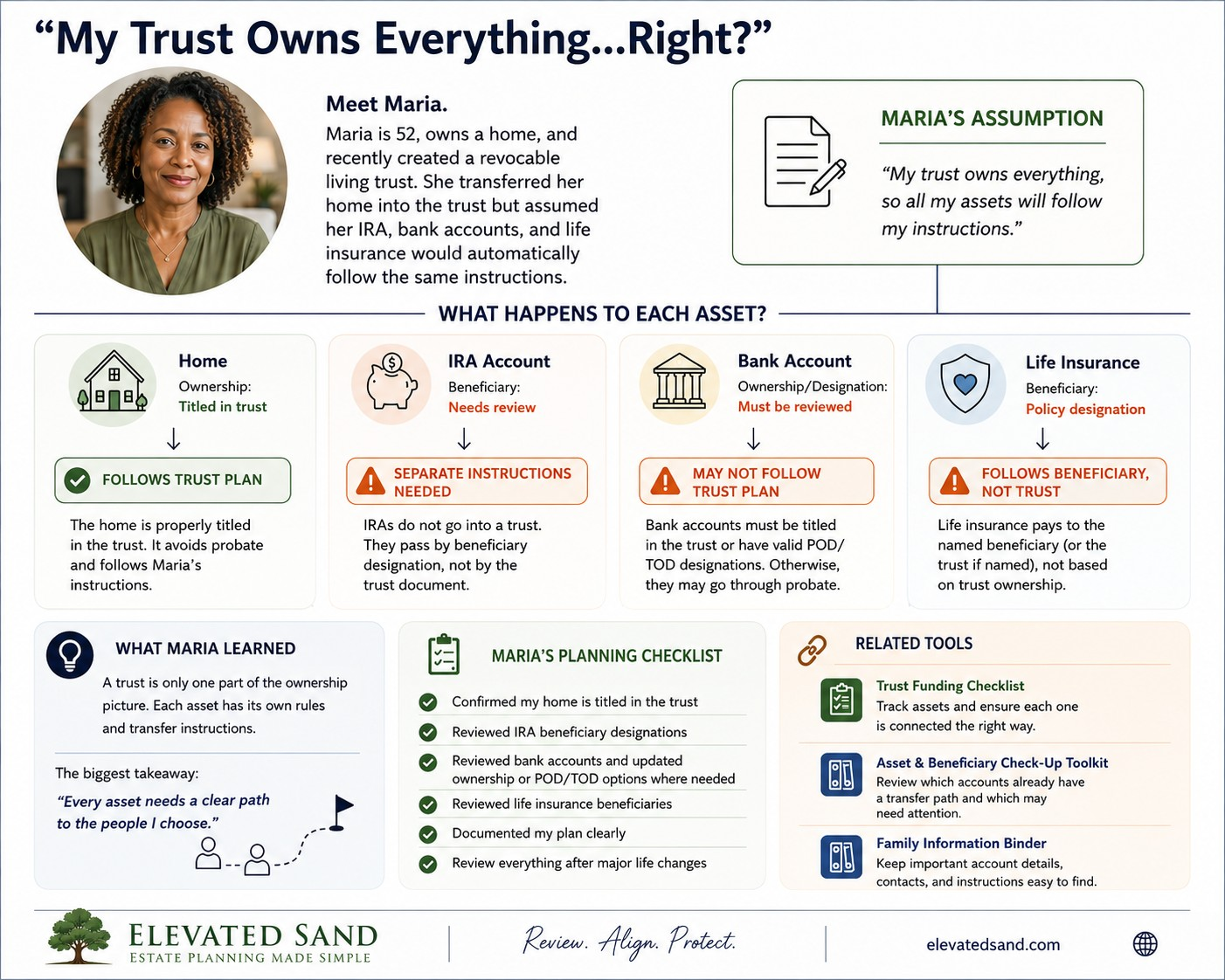
Quick Check Before Adding Any Asset to Your Trust
Ask yourself:
- Does retitling this asset cause taxes or penalties?
- Does it already avoid probate on its own?
- Would beneficiary designation achieve the same result?
- Do I need a trustee to manage this asset after death?
If the answer raises doubt, pause and confirm before transferring it.
Final Takeaway
A revocable living trust is a powerful planning tool — but every asset needs to be handled the right way.
Knowing what not to put in your trust helps you:
- Avoid tax mistakes
- Preserve special protections
- Reduce administrative headaches
- Ensure your estate plan works as intended
Smart trust planning isn’t about putting everything into the trust. More importantly, it’s about putting the right things in the right way.
UP NEXT · PHASE 2, ARTICLE 6
How to Transfer Property into a Trust (Without Costly Mistakes)
Learn how real estate transfers work, why deeds matter, and the steps that help ensure your home is properly connected to your trust.
Resources & Related Reading
Explore trusted, expert sources or related articles for deeper guidance on the topics covered in this phase.
Trusted External Resources
These organizations provide reliable, plain-language information on trusts, estate planning, and asset protection. Content may change over time, but these hubs are regularly maintained and searchable.
🌐 NOLO — Wills, Trusts & Estate Planning Hub
🌐 Fidelity — Estate Planning & Trusts Resource Center
🌐 Charles Schwab — Estate Planning Insights
🌐 ElderLawAnswers — Estate Planning Basics
NOTE: These links are provided for additional education and exploration.
All Phase 2 Articles
Learn how trusts work, when they’re needed, how to fund them, and the key decisions that help families avoid probate and protect assets.
- What Is a Revocable Living Trust?
- Revocable vs. Irrevocable Trusts: Which Fits Your Goals?
- Choosing the Right Trustee for Your Estate Plan
- How to Fund a Revocable Living Trust
- Trust Asset Rules
- How to Transfer Property into a Trust (Without Costly Mistakes)
- Life Estate vs. Living Trust: Which Is Better for Your Home?
- Common Revocable Living Trust Mistakes to Avoid