
How to Fund Your Living Trust
Because a trust only works if it’s properly funded.
Learn what trust funding means, why it matters, and how different types of assets may need to be reviewed so your trust works as intended.
Originally Published: December 2025 • Last Updated: June 2026
At a Glance
YOU ARE HERE:
Estate Planning Series → Phase 2 Article 4 of 8
Introduction: Funding Your Living Trust
Creating a revocable living trust is an important step in estate planning — but creating the document is only the beginning.
A trust works best when the right assets are properly connected to it. This process is called funding your trust.
Without proper funding, some assets may still require additional steps, create delays, or fail to follow the plan you intended.
This article explains what it means to fund a trust, why funding matters, and how different types of assets are commonly reviewed as part of the process.
What Does It Mean to “Fund” a Living Trust?
Funding a trust means connecting assets to your trust through the appropriate method. Depending on the asset, this may involve changing ownership, updating titles, or reviewing beneficiary instructions.
For assets that are retitled – Before funding:
Owner = You individually
For assets that are retitled – After funding:
Owner = Your trust, with you continuing to manage the asset as trustee
Nothing changes in how you use your property. You can still:
- Spend money
- Buy and sell assets
- Refinance property
- Update instructions
- Revoke the trust entirely
The difference is legal ownership — which allows your trust to function during incapacity and after death.
Why Funding Matters After Creating Your Trust
Even a well-written trust may not work as intended if important assets are never connected to it.
If a trust is not funded:
- Assets may still go through probate
- Accounts can be frozen during incapacity
- Courts may become involved
- Loved ones face confusion and delays
Funding is what connects your planning documents to your real-life assets.
FREE DOWNLOAD
📘 Revocable Living Trust Funding Checklist
The Revocable Living Trust Funding Checklist helps you review your assets, understand next steps, and track what still needs attention. View resource →
Common Asset Categories to Review When Funding a Trust
Most families can organize trust funding by walking through these six categories.
1. Real Estate (Homes, Rentals, Land)
Real estate is often one of the largest assets families review when creating a trust.
Common Examples
- Primary residence
- Rental properties
- Vacation homes
- Family land or inherited property
Why Real Estate Belongs in Your Trust
- Avoids probate
- Allows management during incapacity
- Simplifies transfers to beneficiaries
- Prevents court involvement
How Real Estate Is Transferred
Your attorney prepares a new deed transferring ownership from you to your trust. The deed is signed, notarized, and recorded with the county.
Do not attempt to prepare or record deeds yourself. Errors can create title, insurance, or inheritance problems later.
2. Bank Accounts (Checking, Savings, CDs)
Bank accounts are typically funded in one of two ways.
Option A: Retitle the Account to the Trust
This gives your successor trustee immediate access if needed and avoids probate.
Option B: Use Payable-on-Death (POD) Designations
This avoids probate but does not allow trust management during incapacity.
Practical Guidance
- Primary household accounts → may be considered for trust ownership depending on your plan
- Secondary accounts or CDs → POD may be appropriate
Common Mistakes
- Leaving large balances outside the trust
- Assuming POD handles incapacity
- Forgetting updates after life changes
3. Investment & Brokerage Accounts (Non-Retirement)
Many taxable investment accounts can be titled in the name of a revocable living trust.
Common Examples
- Brokerage accounts
- Stocks, bonds, ETFs
- Mutual funds
How Transfers Work
Your financial institution retitles the account into the trust using a trust certification or account conversion form.
This keeps investment management centralized and avoids probate delays.
What Stays Out
- Retirement accounts (covered next)
4. Retirement Accounts (401(k), IRA, Roth IRA)
Retirement accounts cannot be retitled into a living trust during your lifetime without triggering tax consequences.
Instead, these accounts are handled through beneficiary designations.
One possible structure:
- Primary beneficiary → individual beneficiary
- Contingent beneficiary → trust (when appropriate)
This allows tax-efficient transfers while still providing trust-based protection if the primary beneficiary cannot inherit.
Common Mistakes
- Naming the estate as beneficiary
- Forgetting contingent beneficiaries
- Failing to update designations after marriage, divorce, or death
Some situations justify naming the trust as primary beneficiary, but this requires professional guidance.
5. Life Insurance & Annuities
Life insurance is usually handled through beneficiary designations rather than retitling the policy into the trust.
When Naming the Trust Makes Sense
- Minor beneficiaries
- Desire for structured distributions
- Ongoing financial management needs
When It May Not
- When immediate, direct payout is preferred
- When no trustee management is needed
Key Reminder
Old employer policies and forgotten coverage are frequently missed — all policies should be reviewed.
6. Personal Property & Miscellaneous Assets
Personal property is transferred using an Assignment of Personal Property, usually prepared with your trust documents.
Common Examples
- Jewelry and heirlooms
- Artwork and collectibles
- Tools or equipment
Many trusts also include a personal property memorandum, allowing you to name who receives specific items without amending the full trust.
Some Assets Require Special Review
Not every asset should automatically be moved into a trust.
Certain assets require additional consideration, including:
- Retirement accounts
- Health savings accounts
- Some vehicles
- Certain jointly owned assets
- Business interests
The goal is not putting everything into a trust. The goal is making sure each asset has the right transfer plan.
A Simple Trust-Funding Workflow
- Create a full asset inventory
- Categorize each asset
- Follow the correct transfer method
- Keep copies of all confirmations
- Review funding regularly and after major life events
Organization is what gives your plan durability.
What Happens If You Don’t Fund Your Trust?
Without proper funding:
- Probate may still occur
- Assets may be inaccessible during incapacity
- Courts may intervene
- Your instructions may be delayed or ignored
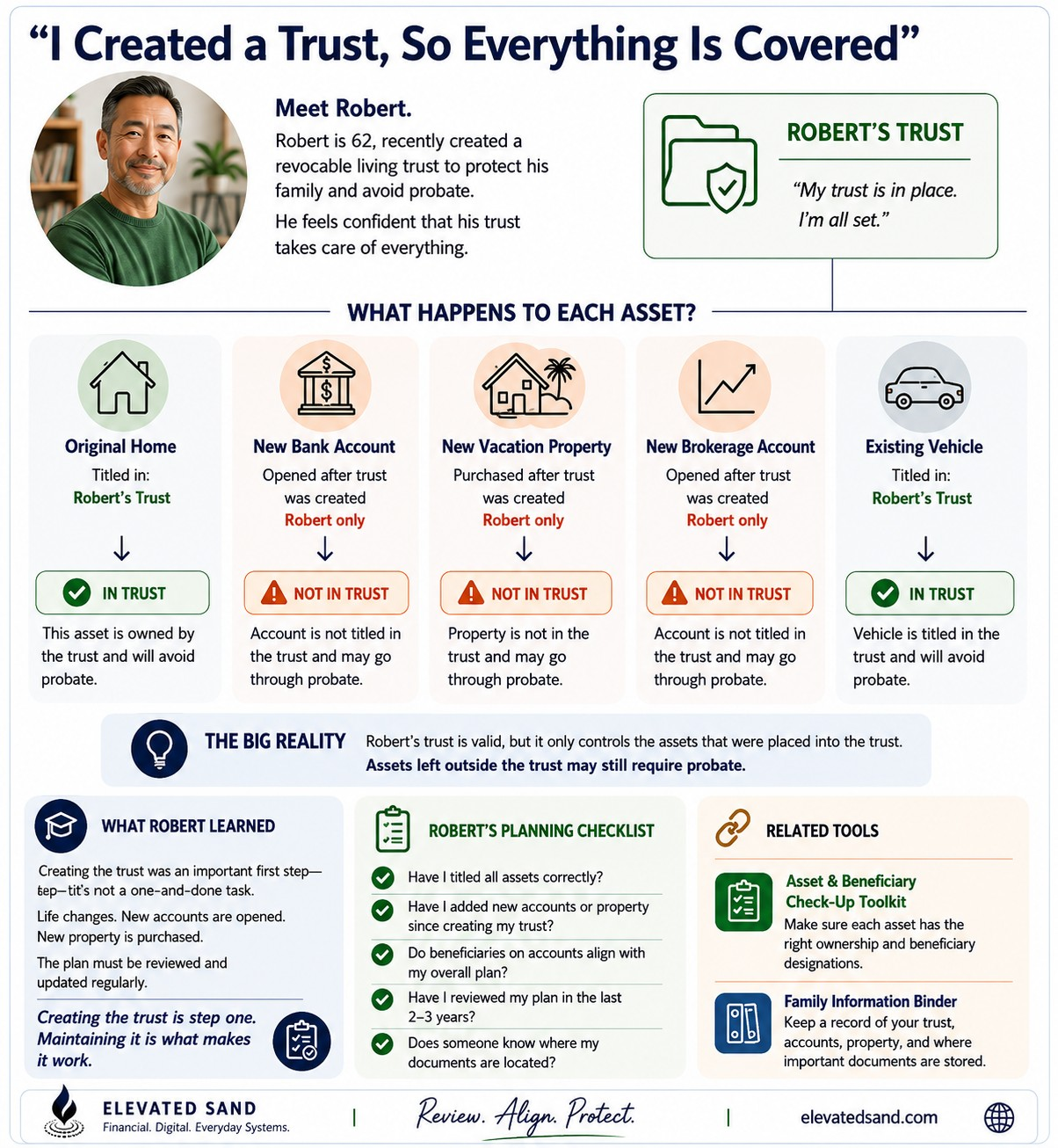
An unfunded or partially funded trust can leave your family managing issues you intended to prevent.
⚖️ Real-Life Planning Scenario
Final Takeaway
A revocable living trust is the roadmap — funding is the engine.
When properly funded, your trust can help:
- Reduce probate complications
- Protect privacy
- Provide continuity
- Reduce confusion
- Carry out your intentions
Next Up: What Assets Should Go Into a Trust?
Learn which assets are commonly placed in a trust, which ones require special handling, and why every asset needs the right transfer strategy.
🔍 External Resources & Related Articles
Explore trusted, expert sources or related articles for deeper guidance on the topics covered in this phase.
📚 Trusted External Resources
These organizations provide reliable, plain-language information on trusts, estate planning, and asset protection. Content may change over time, but these hubs are regularly maintained and searchable.
🌐 NOLO — Wills, Trusts & Estate Planning Hub
🌐 Fidelity — Estate Planning & Trusts Resource Center
🌐 Charles Schwab — Estate Planning Insights
🌐 ElderLawAnswers — Estate Planning Basics
NOTE: These links are provided for additional education and exploration.
🎯 All Phase 2 Articles
Learn how trusts work, when they’re needed, how to fund them, and the key decisions that help families avoid probate and protect assets.
📘 What Is a Revocable Living Trust (and Why Most Families Need One)
📘 Revocable vs. Irrevocable Trusts: Which One Fits Your Goals?
📘 How to Fund Your Living Trust (6 Asset Categories Explained)
📘 Common Mistakes with Trusts (And How to Avoid Them)
📘 Revocable Living Trust Asset Rules
📘 Choosing the Right Trustee
📘 How to Transfer Property into a Trust (and Avoid Costly Mistakes)
📘 Life Estate vs. Living Trust: Which Is Better for Your Home?

Looking for more estate planning tools?
Explore the full collection on our Tools & Resources page.
About the Author: Tonya Harris
Tonya Harris is the founder of Elevated Sand. She creates culturally grounded financial, digital, and real-life education that helps people understand complex systems, make informed decisions, and build stronger foundations for the future.
JOIN THE COMMUNITY
Sign up & get updates
Join our community for practical insights, financial tips, and tools to help you grow, protect, and elevate your life — one step at a time.
Disclaimer: Information is for educational purposes only and should not be considered legal or financial advice. Estate planning involves complex legal and tax considerations. You should consult a qualified estate planning attorney to determine the best approach for your situation and ensure compliance with your state’s laws.