
What Is a Revocable Living Trust and Why Many Families Need One
A clear foundation for modern estate planning.
Learn how a revocable living trust works, what it can do for your family, and why it is often an important part of a well-structured estate plan.
Originally Published: December 2025 • Last Updated: June 2026
At a Glance
YOU ARE HERE:
Estate Planning Series → Phase 2 Article 1 of 8
Introduction: Revocable Living Trusts
When many people hear the word trust, they assume it’s something only wealthy families need. In reality, a revocable living trust can be one of the most practical estate-planning tools for everyday families.
A well-designed and properly funded living trust can help you stay in control during your lifetime, prepare for incapacity, and make things easier for your loved ones after you’re gone.
This article explains what a revocable living trust is, how it works in real life, and why many families choose to include one as part of a complete estate plan.
What Is a Revocable Living Trust?
A revocable living trust is a legal document that allows you to place assets into a trust while keeping full control over them during your lifetime.
The name breaks down simply:
In most cases, you fill multiple roles:
This structure helps create continuity and may reduce the need for court involvement when the trust is properly created and maintained.
Why Many Families Create a Living Trust
The most common reason families create a living trust is to avoid probate. Probate is the court-supervised process of transferring assets after death.
Depending on the situation, probate may involve:
- Additional steps for loved ones during an already difficult time
- Delays before assets are transferred
- Legal or court-related costs
- Public disclosure of certain estate information
A properly funded revocable living trust can allow assets owned by the trust to transfer privately and efficiently outside the probate process.
A living trust also helps families:
- Maintain privacy
- Provide clear instructions during incapacity
- Reduce family conflict
- Customize how and when beneficiaries receive assets
- Create continuity during emergencies or transitions
For many households, these benefits make a trust far more effective than relying on a will alone.
How a Revocable Living Trust Works in Real Life
A living trust follows a straightforward life cycle:
- You create the trust document – Usually with an estate-planning attorney.
- You fund the trust – Assets are retitled into the trust’s name.
- You stay in full control – You can buy, sell, refinance, or change instructions at any time.
- Your successor trustee steps in if needed – If you become incapacitated or after death — without court approval.
- Assets are distributed privately – According to the instructions you created.
This structure keeps your affairs organized and spares your family unnecessary legal hurdles.
FREE DOWNLOAD
📘 Trust Funding Checklist
Creating a trust is only the first step. The Trust Funding Checklist helps you review which assets may need to be connected to your trust so your plan works as intended. View resource →
Common Assets Placed in a Living Trust
Many types of property can be placed into a revocable living trust, including:
Personal Property
- Jewelry and heirlooms
- Artwork and collectibles
- Valuable household items
Real Estate
- Primary residence
- Rental properties
- Vacation homes
- Family land
Bank Accounts
- Checking and savings
- Money market accounts
- Certificates of deposit
Investments
- Brokerage accounts
- Stocks and bonds
- Mutual funds and ETFs
Business Interests
- Family LLCs
- Partnership interests
- Closely held businesses
📌 Important note on retirement accounts:
Most retirement accounts are not retitled into a trust. Instead, beneficiary designations usually control how these accounts transfer. In certain situations, a trust may be named as a beneficiary, but this requires careful planning.
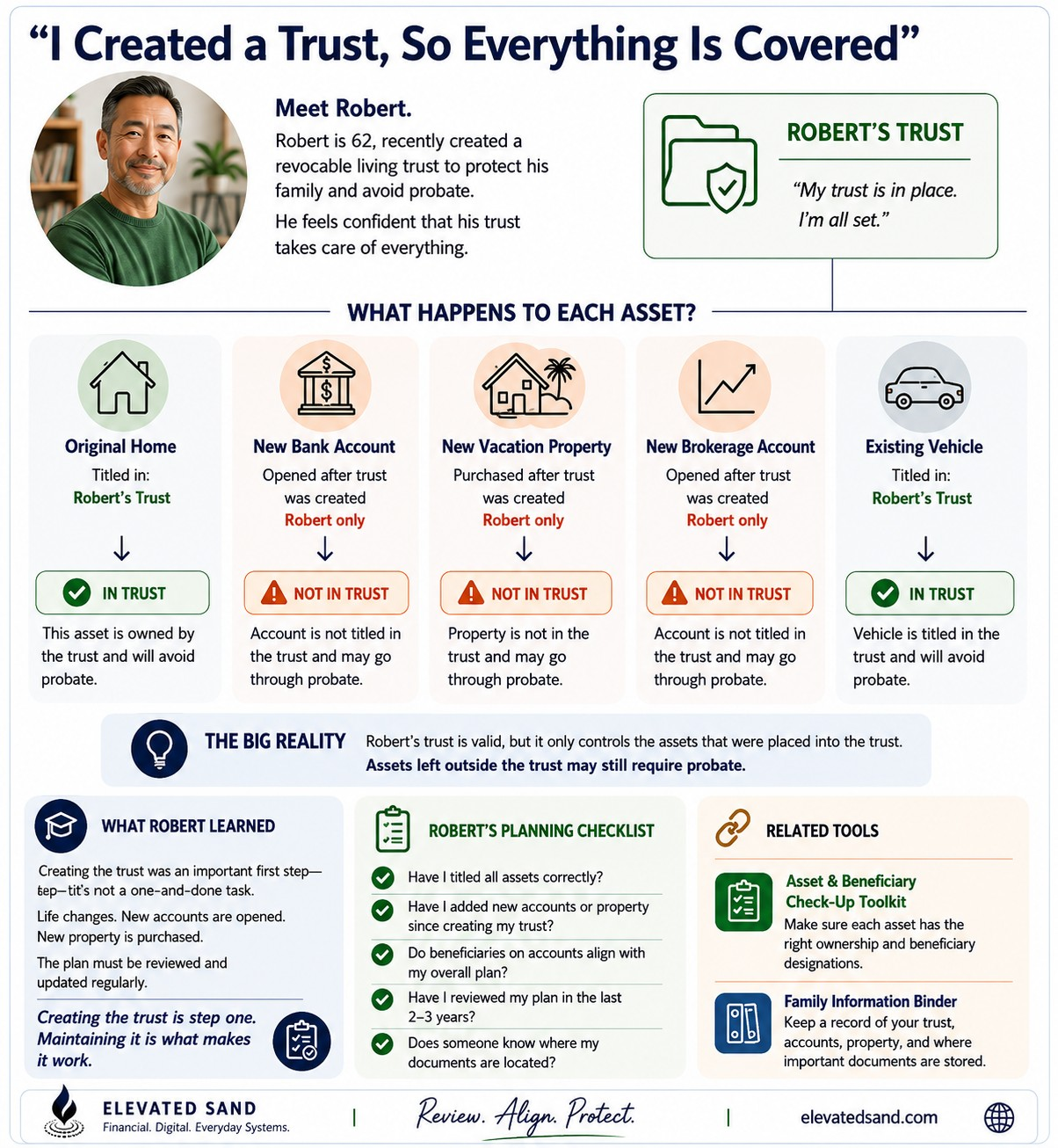
The key is understanding that every asset has its own transfer rules. Creating a trust is only one part of the process — making sure each asset is handled correctly is what helps your overall plan work as intended.
Key Benefits of a Revocable Living Trust
A properly set up living trust offers several meaningful advantages:
- Avoids probate – Faster, private asset transfer
- Maintains your control – Nothing changes while you’re alive and capable
- Helps during incapacity – Allows your chosen successor trustee to step in according to your instructions
- Preserves privacy – Trusts are not public records
- Reduces family conflict – Clear instructions minimize disputes
- Allows flexible inheritance planning – You decide how, when, and under what conditions assets are distributed
What a Living Trust Does Not Do
While powerful, a revocable living trust has limits. It does not:
- Shield assets from creditors while you’re alive
- Reduce taxes by itself
- Replace the need for a will (a pour-over will is still required)
- Override beneficiary designations
- Automatically include assets you forget to fund into it
A trust works best as part of a complete estate plan, alongside powers of attorney, beneficiary reviews, and a current will.
Why a Living Trust Makes Sense for Many Families
Living trusts aren’t just for wealthy households. They may be especially helpful for:
- Homeowners
- Parents of minor children
- Blended families
- Single parents
- Grandparents
- Anyone who values privacy and clarity
- Anyone who wants to reduce stress for loved ones
A trust provides structure when emotions are high and decisions are difficult — which is exactly when planning matters most.
Will vs. Living Trust: A Quick Comparison
| Feature | Will | Revocable Living Trust |
|---|---|---|
| Takes effect | After death | During life and after death |
| Avoids probate | ❌ | ✔️ |
| Privacy | Public | Private |
| Handles incapacity | ❌ | ✔️ |
| Inheritance control | Limited | Highly flexible |
| Best for | Very simple estates | Families seeking clarity and control |
Getting Started with a Living Trust
Creating an effective trust typically involves:
- Listing your assets
- Choosing a trustee and successor trustee
- Naming beneficiaries (and backups)
- Working with an experienced estate-planning attorney
- Properly funding the trust. Funding is the most critical step. An unfunded trust offers little protection.
- Choosing a trustee and successor trustee
FREE DOWNLOAD
📘 Trustee Selection Worksheet
Choosing the right person is one of the most important trust decisions you make. Use this worksheet to think through responsibilities, communication, and readiness. View resource →
Real-Life Planning Scenario
Final Takeaway
A revocable living trust can help create:
1️⃣ Control
2️⃣ Privacy
3️⃣ Flexibility
4️⃣ Clarity for the people you care about
But more importantly, it gives your loved ones clarity when they need it most. The greatest gift you can leave behind isn’t just money — it’s a plan that reduces stress, confusion, and conflict for the people you care about.
Next Up: Revocable vs. Irrevocable Trusts: Which One Fits Your Goals?
Understand the real differences between revocable and irrevocable trusts so you can choose the structure that matches your priorities—not just the name.
🔍 External Resources & Related Articles
Explore trusted, expert sources or related articles for deeper guidance on the topics covered in this phase.
📚 Trusted External Resources
These organizations provide reliable, plain-language information on trusts, estate planning, and asset protection. Content may change over time, but these hubs are regularly maintained and searchable.
🌐 NOLO — Wills, Trusts & Estate Planning Hub
🌐 Fidelity — Estate Planning & Trusts Resource Center
🌐 Charles Schwab — Estate Planning Insights
🌐 ElderLawAnswers — Estate Planning Basics
NOTE: These links are provided for additional education and exploration.
🎯 All Phase 2 Articles
Learn how trusts work, when they’re needed, how to fund them, and the key decisions that help families avoid probate and protect assets.
📘 What Is a Revocable Living Trust (and Why Most Families Need One)
📘 Revocable vs. Irrevocable Trusts: Which One Fits Your Goals?
📘 How to Fund Your Living Trust (6 Asset Categories Explained)
📘 Common Mistakes with Trusts (And How to Avoid Them)
📘 Revocable Living Trust Asset Rules
📘 Choosing the Right Trustee
📘 How to Transfer Property into a Trust (and Avoid Costly Mistakes)
📘 Life Estate vs. Living Trust: Which Is Better for Your Home?

Looking for more estate planning tools?
Explore the full collection on our Tools & Resources page.
About the Author: Tonya Harris
Tonya Harris is the founder of Elevated Sand. She creates culturally grounded financial, digital, and real-life education that helps people understand complex systems, make informed decisions, and build stronger foundations for the future.
JOIN THE COMMUNITY
Sign up & get updates
Join our community for practical insights, financial tips, and tools to help you grow, protect, and elevate your life — one step at a time.
Disclaimer: Information is for educational purposes only and should not be considered legal or financial advice. Estate planning involves complex legal and tax considerations. You should consult a qualified estate planning attorney to determine the best approach for your situation and ensure compliance with your state’s laws.