
What Assets Should Go Into a Trust?
Learn which assets are commonly placed in a revocable living trust, which ones require special handling, and why every asset needs the right transfer strategy.
Originally Published: December 2025 • Last Updated: June 2026
At a Glance
YOU ARE HERE:
Estate Planning Series → Phase 2 Article 5 of 8
Introduction: What Assets Should Go Into a Trust?
Creating a revocable living trust is only the first step. The next decision is understanding how each asset should connect to your overall estate plan.
Some assets are commonly transferred into a trust. Others may use beneficiary designations, special ownership rules, or different transfer methods.
The goal is not putting everything you own into your trust. The goal is making sure every important asset has a clear path to the people you choose.
This article explains which assets are commonly placed into a trust, which ones require caution, and why different assets need different planning strategies.
⚖️ Assets Commonly Placed Into a Revocable Living Trust
Many families use a revocable living trust to manage assets such as:
Real Estate
- Primary homes
- Vacation homes
- Rental properties
- Family land
Financial Accounts
- Certain checking and savings accounts
- Taxable investment accounts
- Brokerage accounts
Personal Property
- Valuable collections
- Family heirlooms
- Important personal belongings
Business Interests
- Certain LLC interests
- Closely held businesses
How each asset is added depends on ownership rules, financial institution requirements, and your overall estate plan.
⚖️ Assets That Require Special Handling
Retirement Accounts (IRA, 401(k), 403(b), Roth IRA)
Retirement accounts generally should not be retitled into the name of your revocable living trust.
Retitling a retirement account is treated as a full withdrawal. That can result in:
- Immediate income taxes
- Loss of tax-deferred or tax-free growth
- Early withdrawal penalties (if applicable)
What to Do Instead
- Keep retirement accounts in your individual name
- Use beneficiary designations to control who inherits them
In certain situations — such as when beneficiaries are minors or need structured distributions — a trust may be named as beneficiary, but this must be done carefully and with professional guidance.
Bottom line: Retirement accounts are controlled by beneficiary rules, not trust ownership.
Health Savings Accounts (HSAs) and FSAs
HSAs and FSAs generally remain outside a revocable living trust because they have special ownership and tax rules.
- These accounts must be individually owned
- They cannot be retitled into a trust
- HSAs become taxable if inherited by anyone other than a spouse
Best Practice
- Name your spouse as beneficiary when possible
- Use HSA funds during your lifetime for qualified expenses
- Coordinate HSA planning separately from trust funding
Transferring an HSA to a trust can destroy the account’s tax advantages.
Vehicles and Trust Planning
Vehicle planning varies by state. While some vehicles can be titled in a trust, many families use other transfer methods when available.
Why It’s Usually Discouraged
- Insurance complications
- DMV retitling fees and paperwork
- Frequent buying and selling creates ongoing maintenance issues
Better Alternatives
- Use state Transfer-on-Death (TOD) titles when available
- Only place high-value, collectible, or specialty vehicles into a trust when advised by an attorney
For most families, daily-use vehicles are simpler to keep outside the trust.
Certain Annuities
Some annuities require special review before changing ownership or beneficiary instructions.
Potential Consequences
- Surrender charges
- Loss of favorable tax treatment
- Early distribution penalties
Correct Approach
- Keep annuities in your personal name
- Name your trust as beneficiary if you want controlled distributions after death
This preserves tax treatment while still allowing your trust to manage the proceeds later.
Accounts That Already Transfer Automatically
Some financial accounts already have transfer instructions built in through beneficiary designations. Before changing ownership, it is important to understand how those instructions work with your trust.
Common Examples
- Bank accounts with POD (Payable on Death) designations
- Brokerage accounts with TOD (Transfer on Death) instructions
- Life insurance policies
- Certain annuities and U.S. savings bonds
Why These Often Stay Out
- Beneficiary designations override trust instructions
- Conflicting paperwork can delay administration
- Some TOD features offer simplicity that a trust does not improve
FREE DOWNLOAD
📘 Trust Asset Eligibility Guide
Every asset needs the right transfer strategy. The Trust Asset Eligibility Guide helps you review common asset types, understand funding options, and identify areas that may need additional guidance. View resource →
When the Trust Might Be Used
If your goal is long-term control — such as delaying inheritance for young beneficiaries — your trust may be named as beneficiary instead of retitling the account.
Assets That Need Additional Review
Some assets fall into gray areas and require individualized decisions:
- Everyday checking accounts
- Out-of-state real estate
- Jointly owned property
- Business interests
These assets are not automatically excluded, but they deserve careful review.
A Simple Rule of Thumb
An asset probably does not belong in your revocable living trust if transferring it would:
- Trigger taxes or penalties
- Eliminate special tax treatment
- Override an effective beneficiary designation
- Create insurance or ownership conflicts
- Require constant retitling with little benefit
In many cases, naming the trust as beneficiary accomplishes the goal more cleanly than transferring ownership.
⚖️ Real-Life Planning Scenario
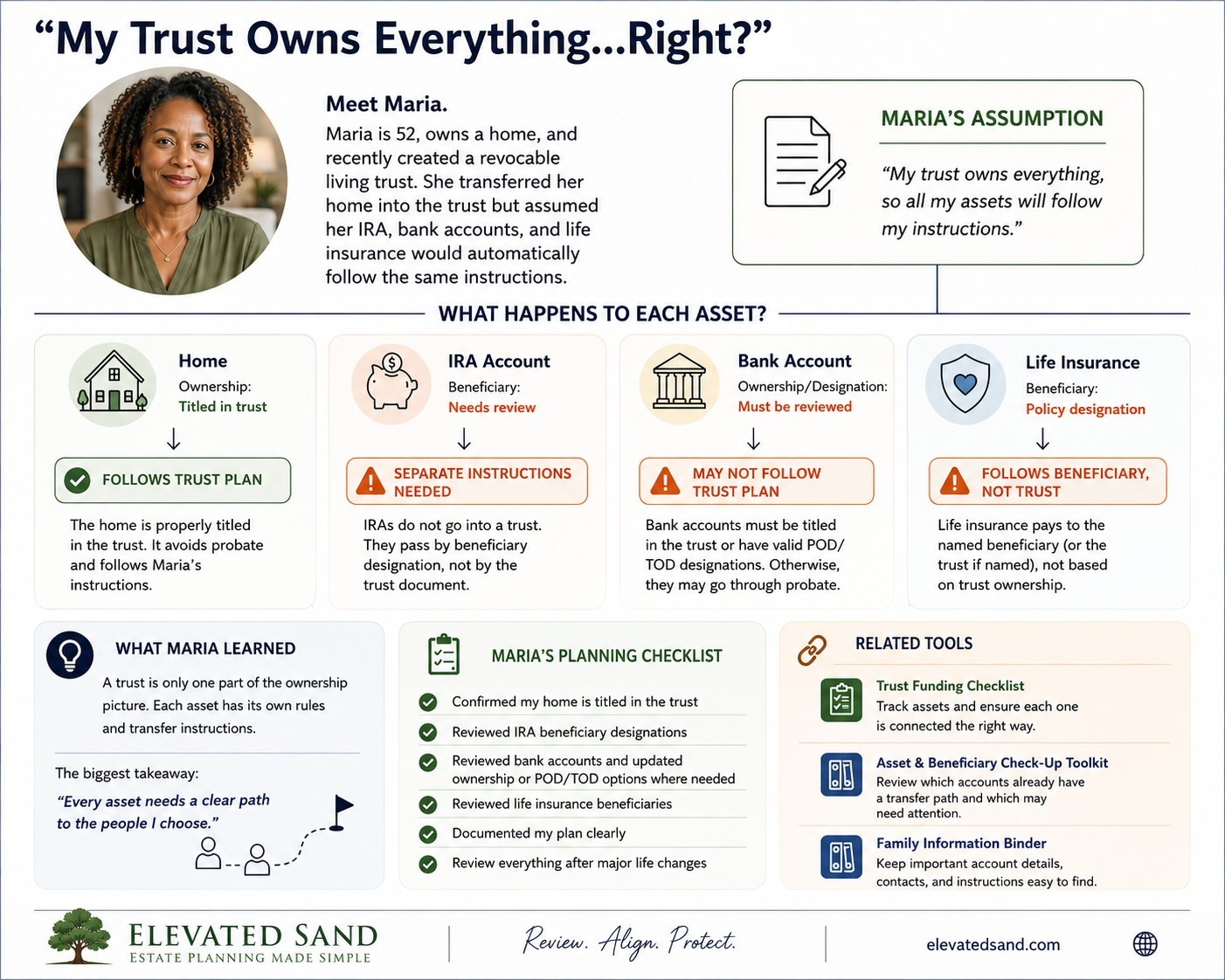
Quick Check Before Adding Any Asset to Your Trust
Ask yourself:
- Does retitling this asset cause taxes or penalties?
- Does it already avoid probate on its own?
- Would beneficiary designation achieve the same result?
- Do I need a trustee to manage this asset after death?
If the answer raises doubt, pause and confirm before transferring it.
Final Takeaway
A revocable living trust is a powerful planning tool — but every asset needs to be handled the right way.
Knowing what not to put in your trust helps you:
- Avoid tax mistakes
- Preserve special protections
- Reduce administrative headaches
- Ensure your estate plan works as intended
Smart trust planning isn’t about putting everything into the trust. More importantly, it’s about putting the right things in the right way.
Next Up: How to Transfer Property into a Trust (Without Costly Mistakes)
Learn how real estate transfers work, why deeds matter, and the steps that help ensure your home is properly connected to your trust.
🔍 External Resources & Related Articles
Explore trusted, expert sources or related articles for deeper guidance on the topics covered in this phase.
📚 Trusted External Resources
These organizations provide reliable, plain-language information on trusts, estate planning, and asset protection. Content may change over time, but these hubs are regularly maintained and searchable.
🌐 NOLO — Wills, Trusts & Estate Planning Hub
🌐 Fidelity — Estate Planning & Trusts Resource Center
🌐 Charles Schwab — Estate Planning Insights
🌐 ElderLawAnswers — Estate Planning Basics
NOTE: These links are provided for additional education and exploration.
🎯 All Phase 2 Articles
Learn how trusts work, when they’re needed, how to fund them, and the key decisions that help families avoid probate and protect assets.
📘 What Is a Revocable Living Trust (and Why Most Families Need One)
📘 Revocable vs. Irrevocable Trusts: Which One Fits Your Goals?
📘 How to Fund Your Living Trust (6 Asset Categories Explained)
📘 Common Mistakes with Trusts (And How to Avoid Them)
📘 Revocable Living Trust Asset Rules
📘 Choosing the Right Trustee
📘 How to Transfer Property into a Trust (and Avoid Costly Mistakes)
📘 Life Estate vs. Living Trust: Which Is Better for Your Home?

Looking for more estate planning tools?
Explore the full collection on our Tools & Resources page.
About the Author: Tonya Harris
Tonya Harris is the founder of Elevated Sand. She creates culturally grounded financial, digital, and real-life education that helps people understand complex systems, make informed decisions, and build stronger foundations for the future.
JOIN THE COMMUNITY
Sign up & get updates
Join our community for practical insights, financial tips, and tools to help you grow, protect, and elevate your life — one step at a time.
Disclaimer: Information is for educational purposes only and should not be considered legal or financial advice. Estate planning involves complex legal and tax considerations. You should consult a qualified estate planning attorney to determine the best approach for your situation and ensure compliance with your state’s laws.