
How to Transfer Property into a Trust Without Costly Mistakes
Learn how real estate transfers work, why the deed matters, and what steps help ensure your home is properly connected to your trust.
Originally Published: December 2025 • Last Updated: June 2026
At a Glance
YOU ARE HERE:
Estate Planning Series → Phase 2 Article 6 of 8
Introduction: Transfer Property into a Trust
Creating a revocable living trust is an important step, but real estate usually needs an additional action before the trust can manage or transfer it as intended.
For a home, rental property, land, or vacation property, that usually means updating the deed so the property is legally titled in the name of the trust.
If real estate is not properly transferred, it may still require probate even if the trust document is well written.
This article explains how real estate transfers into a trust generally work, where mistakes commonly happen, and what steps help protect the plan you intended.
What Does It Mean to “Transfer Property into a Trust”?
TraTransferring real estate into a trust means changing legal title from you individually to you as trustee of your revocable living trust.
Before the transfer:
Owner = You individually
After the transfer:
Owner = You, as trustee of your revocable living trust
You can still live in the home, maintain it, refinance it, sell it, or make changes according to the terms of your trust. The key difference is legal title. When the deed is updated correctly, your successor trustee may be able to manage or transfer the property without unnecessary probate steps.
Why Property Transfers Matter So Much
If real estate is not titled in the name of your trust:
- Probate may be required
- Court delays and costs can apply
- Your successor trustee may have limited authority
- Your instructions may not be followed as intended
Listing property inside the trust document alone is not enough. The deed itself must be updated and recorded.
Real Estate Commonly Reviewed for Trust Ownership
Most families should review these categories carefully.
Real Estate (Homes, Rentals, Land, Vacation Property)
Real estate is the most important asset to transfer. In fact, it is also the most common cause of probate when missed.
Common Examples
- Primary residence
- Rental or investment property
- Vacation homes
- Family land or inherited property
Important Notes
- In many cases, transferring a personal residence into a revocable trust does not trigger a mortgage due-on-sale clause, but the details should still be reviewed before making changes.
- After transfer, you should notify:
- Homeowner’s insurance
- Title insurance
- HOA or condo association (if applicable)
Rental properties may require additional planning, such as LLC ownership with the LLC interest placed into the trust.
Assets That Should Not Be Transferred Into the Trust
Some property situations require individualized planning.
Typically Excluded
- Retirement accounts (401(k), IRA, Roth IRA, etc.)
- Daily-use vehicles (in most states)
- HSAs, FSAs, and MSAs
- Certain annuities
These assets are usually handled through beneficiary designations instead of ownership changes.
Case-by-Case Property Decisions
Some real estate transfers are more complex than a basic home transfer.
Jointly Owned Property
Joint ownership may already provide a transfer path, but it can also conflict with trust instructions. The right approach depends on the co-owner’s rights, your goals, and how the property is titled.
Out-of-State Real Estate
Real estate owned in another state may create additional probate concerns. A trust can sometimes help reduce that risk, but the deed must be handled correctly under that state’s rules.
Rental or Business-Use Property
Rental property, multi-unit property, or property connected to a business may require additional review before changing title.
These situations do not mean a trust is wrong. They simply mean the transfer should be reviewed carefully before recording a new deed.
Step-by-Step: How to Transfer Real Estate into Your Trust
These steps reflect the standard, legally accepted process in most states.
Step 1: Confirm Current Ownership
Locate your existing deed and confirm:
- Exact legal names
- Co-ownership details
- Existing liens or mortgages
Step 2: Determine the Correct Deed
Most transfers use:
- Quitclaim Deed (common for trust transfers)
- Warranty or Grant Deed (used in some states)
Your attorney selects the correct form.
Step 3: Prepare the New Deed
The deed must transfer ownership from you → to you as Trustee of your trust (using the exact trust name and date). Keep in mind, small errors in names or dates can cause rejection.
Step 4: Sign and Notarize
All states require notarization; some require witnesses. Use the full legal description from the prior deed — not a street address.
Step 5: Record the Deed
Recording the deed with the county creates the public record of the transfer. Requirements vary by state, so this step should be completed carefully.
Step 6: Update Insurance
Add the trust as an additional insured or interest on your homeowner’s policy.
Step 7: Notify Lenders and HOAs
Mortgage lenders, HOAs, and condo associations may need updated records after the transfer. Confirm notice requirements before and after the deed is recorded.
FREE DOWNLOAD
📘 Trust Funding Checklist
Transferring real estate is one part of trust funding. Use the Trust Funding Checklist to review which assets are connected to your trust and which items still need attention. View resource →
Common Property Transfer Mistakes to Avoid
- Creating a trust but never transferring the property
- Forgetting to record the deed
- Using the wrong trust name or date
- Leaving out the legal description
- Failing to update insurance records
- Removing property for refinancing and never adding it back
- Forgetting to retitle newly acquired property
These mistakes can create delays, confusion, or probate issues even when a trust exists.
⚖️ Real-Life Planning Scenario
Maria created a trust and transferred her home correctly, but later assumed her IRA, bank accounts, and life insurance automatically followed the same instructions. Her scenario shows why each asset needs its own transfer path.
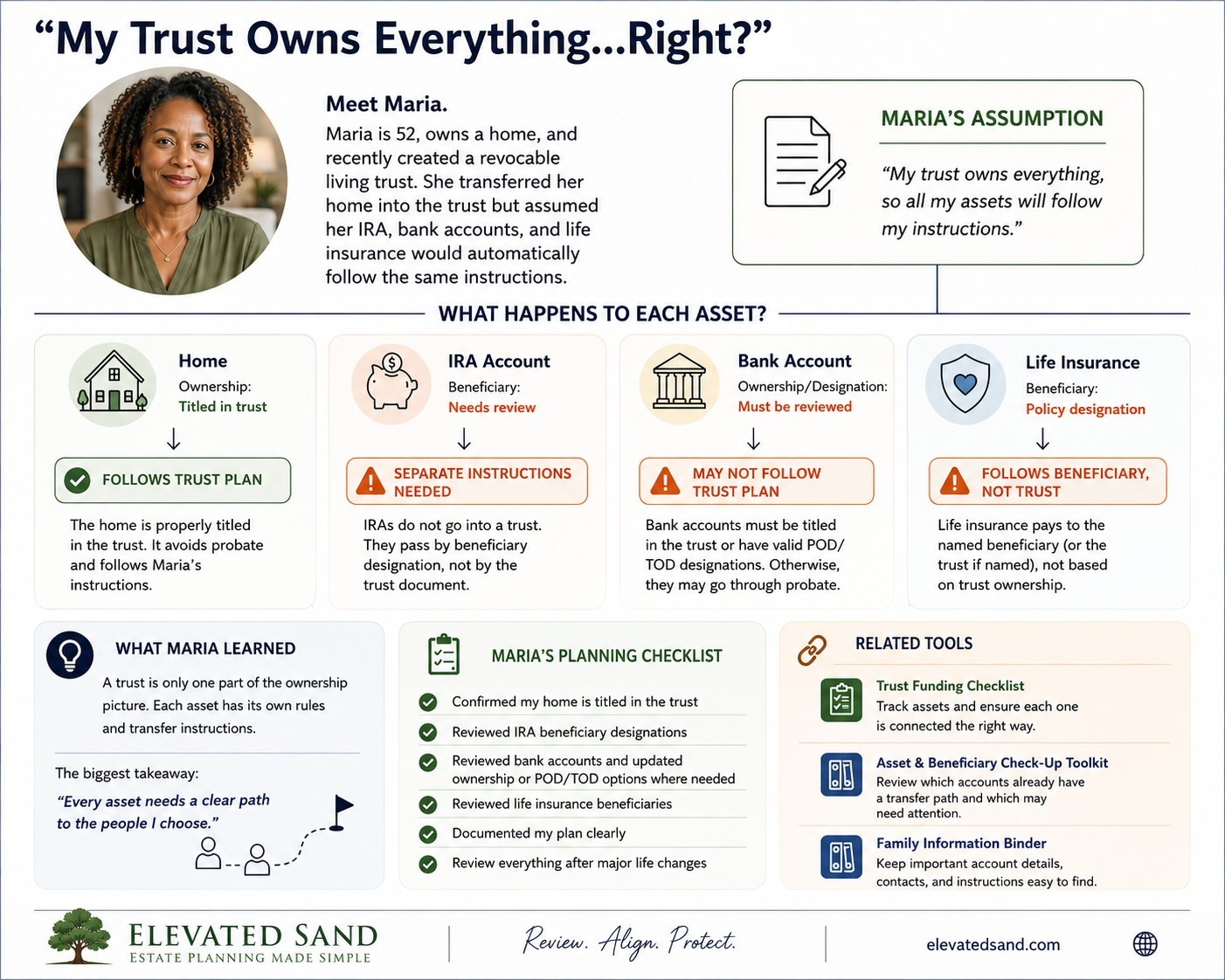
🔎 View Full Scenario → Explore more Estate Planning Scenarios
Should You Hire an Attorney?
Because deed requirements vary by state and property type, professional help is strongly recommended if:
- The property has liens or title issues
- You own rental or multi-unit property
- You have a blended family
- You own property in multiple states
- Your trust has complex distribution instructions
The cost of professional help is often far less than the cost of fixing mistakes later.
Final Takeaway
Transferring real estate into your trust does not have to be overwhelming, but it does need to be done correctly.
When handled correctly, a real estate transfer can help:
- Reduce probate complications
- Preserve privacy
- Support continuity
- Give your successor trustee clearer authority
- Carry out your instructions
Your trust is the plan. Proper transfers are what make the plan work.
Next Up: Life Estate vs. Living Trust — Which Is Better for Your Home?
Compare life estates and living trusts to understand how each option affects control, flexibility, probate, and the future of your home.
🔍 External Resources & Related Articles
Explore trusted, expert sources or related articles for deeper guidance on the topics covered in this phase.
📚 Trusted External Resources
These organizations provide reliable, plain-language information on trusts, estate planning, and asset protection. Content may change over time, but these hubs are regularly maintained and searchable.
🌐 NOLO — Wills, Trusts & Estate Planning Hub
🌐 Fidelity — Estate Planning & Trusts Resource Center
🌐 Charles Schwab — Estate Planning Insights
🌐 ElderLawAnswers — Estate Planning Basics
NOTE: These links are provided for additional education and exploration.
🎯 All Phase 2 Articles
Learn how trusts work, when they’re needed, how to fund them, and the key decisions that help families avoid probate and protect assets.
📘 What Is a Revocable Living Trust (and Why Most Families Need One)
📘 Revocable vs. Irrevocable Trusts: Which One Fits Your Goals?
📘 How to Fund Your Living Trust (6 Asset Categories Explained)
📘 Common Mistakes with Trusts (And How to Avoid Them)
📘 Revocable Living Trust Asset Rules
📘 Choosing the Right Trustee
📘 How to Transfer Property into a Trust (and Avoid Costly Mistakes)
📘 Life Estate vs. Living Trust: Which Is Better for Your Home?

Looking for more estate planning tools?
Explore the full collection on our Tools & Resources page.
About the Author: Tonya Harris
Tonya Harris is the founder of Elevated Sand. She creates culturally grounded financial, digital, and real-life education that helps people understand complex systems, make informed decisions, and build stronger foundations for the future.
JOIN THE COMMUNITY
Sign up & get updates
Join our community for practical insights, financial tips, and tools to help you grow, protect, and elevate your life — one step at a time.
Disclaimer: Information is for educational purposes only and should not be considered legal or financial advice. Estate planning involves complex legal and tax considerations. You should consult a qualified estate planning attorney to determine the best approach for your situation and ensure compliance with your state’s laws.