
Georgia HB 369: What It Means and Why It’s Raising Questions
A clear look at the proposed shift to nonpartisan elections—and why many are asking if it should apply statewide.
Published April 2026
At a Glance
Community Awareness • Georgia Civic Topic
🗳️ Introduction: Georgia HB 369
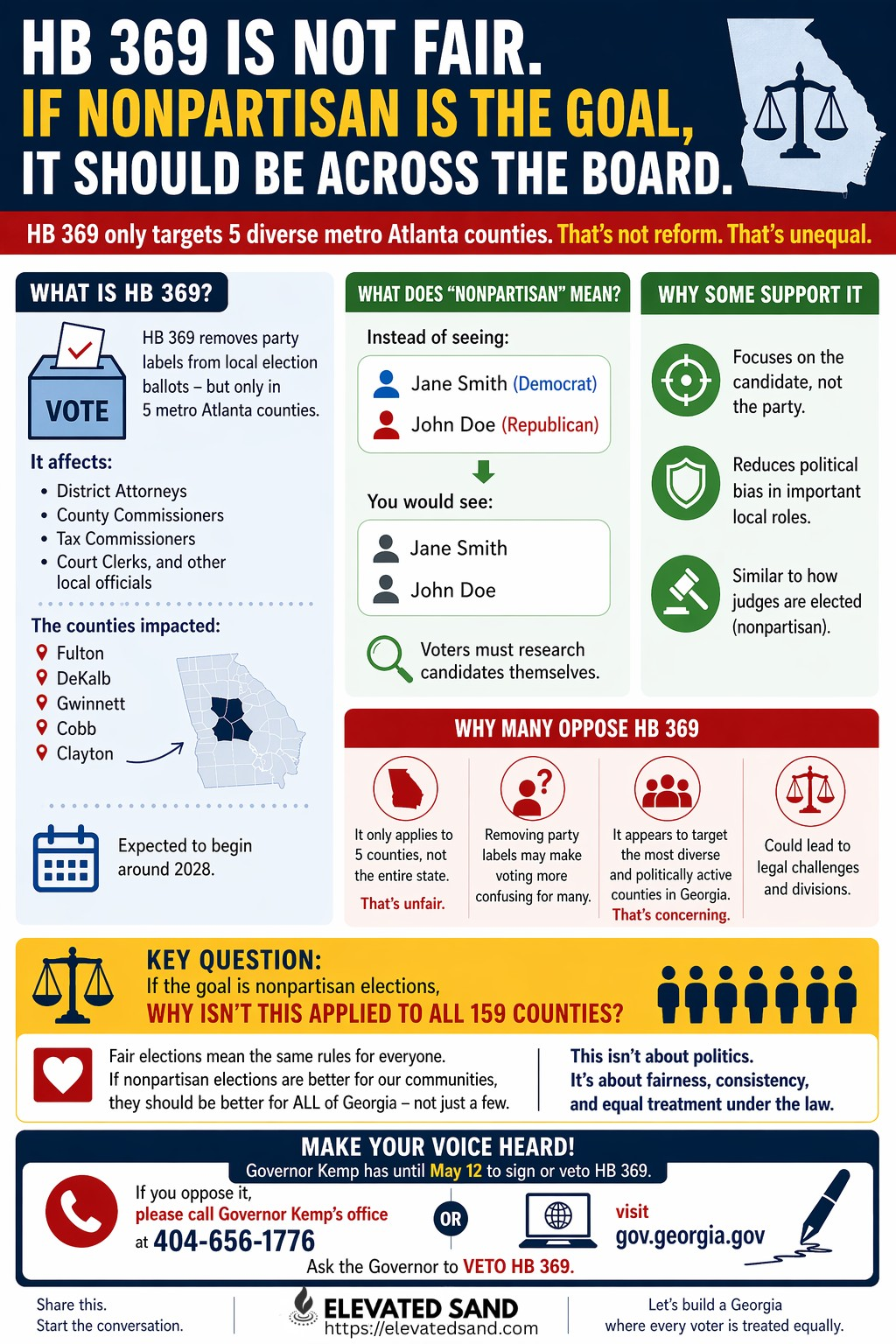
If you’ve been seeing conversation around Georgia House Bill 369 (HB 369), you’re not alone. At a high level, the bill would remove political party labels from certain local election ballots, which means voters would no longer see whether a candidate is a Democrat or Republican for some local offices.
What’s drawing attention, though, is not just what the bill does—but where it applies. HB 369 would affect five metro Atlanta counties only, rather than being implemented statewide.
The visual below highlights the key points and questions surrounding HB 369 in a quick, easy-to-follow format.
⚖️ Key Question
If nonpartisan elections are meant to improve how voting works, should that change apply to all counties equally?
This question is at the center of why HB 369 is getting attention—not just for what it changes, but how those changes are applied.
⚖️ Why This Is Getting Attention
For many people, the conversation is not simply about partisan versus nonpartisan elections. It is about consistency. If removing party labels is intended to improve how elections work, a key question being raised is whether that change should apply to all counties equally.
That question is part of what has made HB 369 a topic of broader public interest. Even people trying to stay neutral on the politics of it may still want to understand whether the same rules are being applied fairly across the state.
⏳ What Happens Next
The governor can sign the bill, veto it, or allow it to become law without taking action. That timeline is why many people are paying attention right now and trying to understand what the bill actually means before reacting to social media posts or headlines.
🧠 Bottom Line
HB 369 is about more than removing party labels from ballots. It also raises a larger question about how election changes are applied and whether those changes should be consistent across all communities.
If you are just starting to look into this issue, the infographic above gives a quick visual breakdown, while this article provides the broader framing behind why the bill is receiving attention.
About the Author: Tonya Harris
Tonya Harris is the founder of Elevated Sand. She creates culturally grounded financial, digital, and real-life education that helps people understand complex systems, make informed decisions, and build stronger foundations for the future.
JOIN THE COMMUNITY
Sign up & get updates
Join our community for practical insights, financial tips, and tools to help you grow, protect, and elevate your life — one step at a time.
Disclaimer: Content in this section is provided for educational and community awareness purposes only. It is not intended to promote or oppose any political party, candidate, or position. The goal is to present information in a clear, accessible way so readers can better understand topics that may impact their communities and make informed decisions based on their own research.