
Estate Planning Series Now Live! Educational Guides & Downloadable Resources: Explore The Series → New Civic Guide & Download: Georgia Voters: How to Check Your Registration Status Get Started → New: Homeowner Financial Guidance on Property Taxes & Homestead Exemptions Learn More →

Category: Financial Tools

  • 5 Smart Money Moves

    5 Smart Money Moves

    5 Smart Money Moves to Make Before Year-End

    Wrap up your finances with clarity and confidence. Consider these Smart Money Moves today for a stronger tomorrow.

    End-of-year isn’t just about wrapping gifts — it’s the perfect time to wrap up your finances with clarity. Before the calendar flips, a few small steps can help you save smarter, stress less, and set up for a strong new year. Whether you’re adjusting after unexpected expenses, paying down debt, or planning your next move, these five “money moments” will help you finish strong and start fresh.

    Even better: share these tips with your kids — it’s never too early to build smart money habits.

    1. Review Your Spending & Subscriptions

    Take 15 minutes to scan your bank statements or budgeting app. Are there streaming services, memberships, or apps you don’t use? Cancel or pause them before the next billing cycle. Reinvest that money into savings or a small “fun fund” for family experiences.

    💡Pro Tip:

    Try the 80/20 method — cut 20% of expenses that bring the least joy.

    🎯 Bonus Insight:

    This small cleanup can free up $300–$500 a year — funds you can redirect toward an emergency fund or debt snowball.

    👧🏽 Kid Connection:

    Budget Detective Game — Have your kids look over a list of family expenses (like apps or memberships) and guess which are “needs” vs. “wants.” It’s a fun way to teach value awareness early.

    2. Automate One Positive Habit

    If saving or debt payments keep slipping through the cracks, automation is your secret weapon. Set up one recurring transfer — even $25/month — toward savings, investments, or debt payoff.

    💡Pro Tip:

    Rename the account “Future Me” or “Family Goals” to make it feel personal and purposeful.

    🎯 Bonus Insight:

    Automatic transfers remove the “decision fatigue” that keeps people from saving — what’s out of sight builds wealth in silence.

    👧🏽 Kid Connection:

    Jar Automation — Create three jars: Spend, Save, Give. Let your kids “transfer” their allowance weekly. This physical act mimics what adults do digitally and helps build consistency.

    3. Check Your Credit Report & Utilization

    Request your free credit report at AnnualCreditReport.com. Compare your statement date and due date — paying down balances before the statement closes can lower utilization and raise your score.

    💡Pro Tip:

    Don’t chase perfection — focus on progress.

    🎯 Bonus Insight:

    Set a phone reminder: “Pay credit cards before statement closes.” It’s one of the easiest hacks to improve your credit without new accounts.

    👧🏽 Kid Connection:

    Teen Credit Talk — For teens, connect the dots between debit card responsibility and credit in the future. Discuss how credit reflects trust — and how borrowing means paying yourself back later.

    4. Update Beneficiaries & Emergency Info

    Life changes fast — marriages, births, losses. Check your bank, insurance, and retirement accounts to ensure your beneficiaries reflect your current wishes.

    💡Pro Tip:

    It’s one of the simplest steps to keep your loved ones protected and your legacy clear.

    🎯 Bonus Insight:

    Also update emergency contacts on apps, phone, and digital accounts — small details matter in times of crisis.

    👧🏽 Kid Connection:

    Explain Beneficiaries — Tell kids, “It’s how we choose who gets to help with our things if something happens.” This builds understanding about planning, responsibility, and trust.

    5. Set a Micro-Goal for the Next Quarter

    Choose one small, measurable goal:

    • Launch a side project
    • Pay down $200 of debt
    • Save $300
    • Open a Roth IRA

    💡Pro Tip:

    Celebrate completion, not perfection. Write your goal where you can see it.

    🎯 Bonus Insight:

    Micro-goals create momentum. A small win releases dopamine — the “motivation molecule” that keeps habits alive.

    👧🏽 Kid Connection:

    Goal Jar Challenge — Let your child pick one “goal jar” (toy, book, trip). Add coins weekly. When they reach it, celebrate together — it teaches patience, progress, and reward.

    JOIN THE COMMUNITY

    Join our community to get insights, smart money tips, and tools to help you grow, protect, and elevate your life — one step at a time.

  • Health Crisis & Marriage Considerations

    Health Crisis & Marriage Considerations

    Health Crisis & Marriage Considerations

    A Relatable Scenario

    Michael and Sarah, married for 18 years, share a home, a joint checking account, and a life built together. Michael manages their investments and a rental property, while Sarah runs their household finances. One day, Michael suffers a sudden stroke. Sarah rushes to the hospital, overwhelmed with worry, but soon faces unexpected obstacles:

    • She can’t access his investment accounts to pay bills.
    • The rental property is solely in Michael’s name.
    • Doctors hesitate to proceed with treatment without documentation
    • Sarah assumed her role as a spouse gave her automatic authority, but it didn’t.

    The Marriage Myth: Why It’s Not Enough

    Many couples assume marriage gives automatic control over each other’s finances, property, and healthcare decisions. The truth is:

    • Joint bank accounts are accessible, but individual accounts are frozen without a Power of Attorney.
    • Property in one name requires legal authority to manage.
    • Healthcare decisions may be delayed if there’s no documentation.
    • Without planning, court involvement is likely, making the process public, costly, and stressful.

    Side-by-Side: Planning Ahead vs. No Planning

    AreaIf You’ve Planned AheadIf You Haven’t Planned Ahead
    Financial AccountsA POA lets your spouse access and manage your accounts.Accounts frozen; must seek conservatorship through court.
    PropertyJoint ownership or trust ensures seamless management.Property in one name is untouchable without court approval.
    Healthcare DecisionsAdvance Directive + Healthcare POA make decisions clear.Doctors may hesitate or defer decisions; court involvement likely.
    Time & CostMinimal cost, quick action, no court oversight.Weeks to months, attorney fees, court filings, and mandatory reporting.
    Stress LevelPrivacy and peace of mind.Stressful, public, and emotionally draining.

    Key Planning Documents to Put in Place

    DocumentWhy It MattersResource
    Durable Power of Attorney (POA)Grants trusted person authority to handle finances and property.Georgia POA Guide
    Advance Directive for HealthcareOutlines healthcare wishes and designates a decision-maker.Georgia Advance Directive Form
    Living TrustAvoids probate, simplifies asset transfer, and protects privacy.Nolo’s Living Trust Basics
    Beneficiary DesignationsEnsures retirement accounts and insurance go to intended recipients.Fidelity Beneficiary Guide

    If You Haven’t Planned Ahead

    If you don’t have these documents, your loved ones may need to seek guardianship or conservatorship:

    • Guardianship: Court grants authority over personal and healthcare decisions.
    • Conservatorship: Court grants authority over financial matters.
    • Emergency Options: In urgent cases, courts may issue emergency orders to provide temporary authority (covered in your companion article).

    🔗 Learn more:

    Helpful Resources

    ResourceLink
    Video: POA vs Guardianship ExplainedWatch Here
    Advance Directive WalkthroughDownload PDF
    Nolo’s Estate Planning BasicsRead Guide
    Find Your County Probate CourtGA Probate Court Directory

    Tools to Stay Organized

    Family Legacy Binder: Create a binder with all critical documents:

    • Wills, Trusts, POAs, Advance Directives
    • Bank info, property deeds, insurance, passwords
    • Contact list for attorneys, doctors, financial advisors

    Password Manager or Spreadsheet: Use LastPass, 1Password, or a secure spreadsheet to keep logins centralized. Include instructions for your spouse to access accounts.

    Annual Check-Up: Review legal and financial documents yearly or after major life changes.

    Don’t wait until a crisis strikes to discover legal red tape.

    Take control today:

    ✅ Draft your POA and Advance Directive.
    ✅ Organize your family binder.
    ✅ Schedule a consultation with an estate planning attorney.

    Downloadable Resource:

    Download the Health Crisis Planning Checklist

    JOIN THE COMMUNITY

    Join our community to get insights, smart money tips, and tools to help you grow, protect, and elevate your life — one step at a time.

    About the Author
    Written by Tonya Harris, founder of Elevated Sand. Tonya creates culturally grounded financial and digital education that helps people understand complex topics and make informed decisions for the future.

    Learn more about Elevated Sand

  • Emergency Guardianship or Conservatorship in Georgia

    Emergency Guardianship or Conservatorship in Georgia

    Emergency Guardianship or Conservatorship in Georgia


    Do you need a guardianship or conservatorship – Georgia

    An emergency guardianship/conservatorship grants temporary decision-making power if an incapacitated person faces:

    • Immediate risk of death, serious physical injury, or illness, or
    • Irreparable loss or dissipation of assets

    How Quickly Can It Be Granted?

    Courts appoint an emergency guardian/conservator immediately, or within 3–5 days of filing, when the risk is well-documented.


    Duration & Scope

    • Emergency guardianship typically lasts up to 60 days and ends when:
      • A permanent guardian/conservator is appointed
      • The court removes the emergency order
    • A pre-hearing emergency guardian may be appointed even before the court hearing. However, this only valid only until the hearing occurs.

    Reference: Public Guardianship for Adults – PAMMS


    Step-by-Step: What She Should Do Now

    1. Gather Immediate Documentation
      • Obtain a sworn affidavit of incapacity from a physician, psychologist, or licensed social worker.
      • Include evidence of urgent financial risk (e.g., unpaid bills, risk of foreclosure, income loss from rental properties).
    2. File an Emergency Petition
      • Use the “Petition for the Appointment of an Emergency Guardian and/or Conservator for a Proposed Ward” form. Ga Supreme Court Forms Repository.
      • Submit the completed for to the local Probate Court. You should file in your county of residence. Location Matters because Georgia law requires that petitions for guardianship or conservatorship (emergency or permanent) be filed in the county of the proposed ward’s domicile or where they’re currently located. GA Probate Court Directory
    3. Request an Emergency Hearing
      • Clearly state the immediate risk or harm to life, health, or property.
      • Courts can grant expedited hearings and issue orders rapidly (often within 3–5 days).
    4. Prepare for Court
      • Provide all documentation:
        • Petition form
        • Medical affidavit
        • Evidence of financial danger
      • Be ready for the court to
        • Appoint an independent attorney for the incapacitated spouse
        • Schedule hearings and possible evaluations
    5. Obtain Emergency Order
      • If granted, the court issues Letters of Emergency Guardianship or Conservatorship, which gives temporary legal authority.
    6. File Permanent Petitions Concurrently
      • Some courts allow emergency and permanent guardianship petitions to be filed together to save time. PAMMS
      • A permanent process typically takes 4–6 weeks to complete.

    Summary: Emergency Roadmap

    ActionWhy It Matters
    File emergency petition + medical affidavitEnables same-day or expedited court review
    Walk-in or schedule expedited hearingSpeeds up legal access
    Secure emergency authorityAllows immediate bill paying, rent collecting, and property management
    File permanent petitions in parallelAvoids power gaps after emergency period ends
    Track all filingsEnsures compliance with court requirements and reporting

    By moving swiftly with an emergency conservatorship, you can begin managing banking, properties, and business affairs within days rather than waiting weeks or months for routine probate.


    Emergency Guardianship & Conservatorship Quick-Reference Checklist

    This checklist provides step-by-step actions to expedite emergency guardianship or conservatorship in Georgia. It is designed for spouses or family members needing urgent legal authority to handle finances, property, or healthcare.

    • Gather all necessary documentation such as IDs, marriage certificate, property deeds, financial records.
    • Obtain a sworn medical affidavit from a doctor, psychologist, or licensed social worker confirming incapacity.
    • Complete the Petition for the Appointment of an Emergency Guardian and/or Conservator form which can be obtained on Georgia Probate Court websites.
    • File the emergency petition with your local Probate Court; request expedited or same-day review if possible.
    • Provide supporting evidence of immediate risk to health, property, or finances.
    • Attend the emergency hearing (scheduled within 3–5 days in urgent cases).
    • Receive Letters of Emergency Guardianship/Conservatorship, granting temporary authority (valid for up to 60 days).
    • Simultaneously, file for permanent guardianship and/or conservatorship to ensure long-term authority.
    • Follow all court reporting requirements (inventory of assets, accounting reports, deadlines).
    • Consult an elder law or probate attorney to help navigate the process and avoid delays.

    Tips for Speeding Up the Process

    • Call your county Probate Court ahead to confirm required forms and walk-in hours.
    • Bring multiple copies of all documents and IDs.
    • Prepare a clear written statement describing risks to your spouse’s health or property.
    • Ask if you can file emergency and permanent petitions at the same time, and
    • Keep a binder or folder to track all filings and court correspondence.

    JOIN THE COMMUNITY

    Join our community to get insights, smart money tips, and tools to help you grow, protect, and elevate your life — one step at a time.

  • When You Pay Matters: The Credit Score Tip Most People Miss

    When You Pay Matters: The Credit Score Tip Most People Miss

    When You Pay Matters

    Why does credit utilization payment timing matter?

    Most people know it’s important to pay their credit card bill on time—but when you pay matters and could make or break your credit score.

    💡 The timing of your payment matters just as much as whether you pay it.

    If you’re working to improve your credit, here’s a credit score tip that’s often overlooked but easy to fix once you understand how it works.


    The Problem

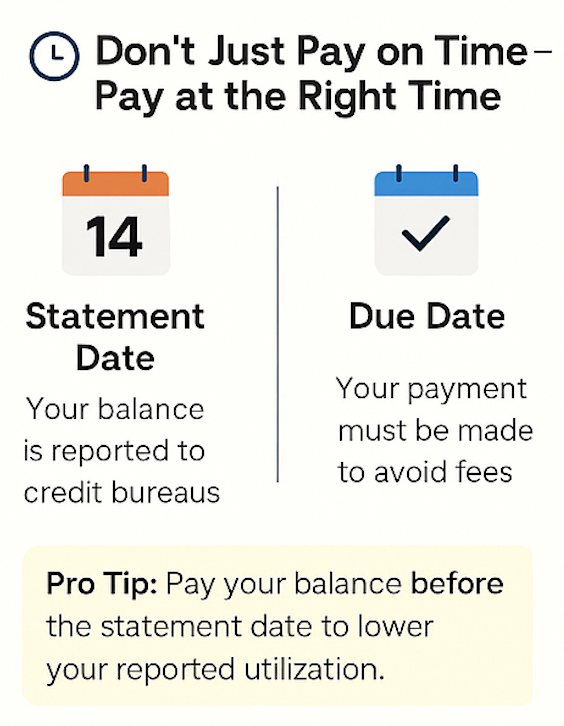
    Your credit card company reports your balance to the credit bureaus on the statement date—not the due date. So even if you pay your card off in full by the due date, your reported balance may still appear high if you had a large balance on your statement date.

    Why does this matter? Because one of the biggest factors affecting your credit score is something called credit utilization.


    What is Credit Utilization?

    Credit utilization is how much of your available credit you’re using. It’s calculated like this:

    Balance ÷ Credit Limit × 100 = Utilization %

    For example:

    • If your limit is $2,000 and your balance is $1,000 on your statement date, you’re using 50% of your credit.
    • Experts recommend keeping this under 30%, and ideally under 10% to boost your score.

    The Fix: Pay Before the Statement Date

    Want your score to reflect lower balances? Just pay early.

    🕒 Paying before the statement date (instead of the due date) ensures a lower balance gets reported to the credit bureaus, which lowers your utilization and improves your score.


    Smart Habits That Boost Your Credit

    ✅ Pay before your statement date
    ✅ Keep your utilization under 30%
    ✅ Avoid closing old accounts
    ✅ Set up reminders to avoid late payments
    ✅ Track balances, APRs, and due dates with a tool that works


    Downloadable Resource Pack:

    • Free Credit Card Tracker
    • Smart Credit Habits Infographic

    To help you stay on top of everything—from balances and due dates to APRs and promo periods—we’ve created a simple, editable Credit Card Tracker you can use right now.

    You’ll be able to:

    • Monitor all your credit cards in one place
    • Track statement vs. due dates
    • See utilization rates at a glance
    • Store APRs, promo expirations, and custom notes

    Good credit isn’t just about paying on time—it’s about managing the details that lenders see behind the scenes. A small change in timing can make a big difference. Build smart habits and take control of your financial future one move at a time.


    Explore the Learning Hub
    Practical explanations for real-life systems

    Tools & Resources
    Worksheets, guides, and templates you can use immediately

    JOIN THE COMMUNITY

    Join our community to get insights, smart money tips, and tools to help you grow, protect, and elevate your life — one step at a time.